
Horizons 02, 2024
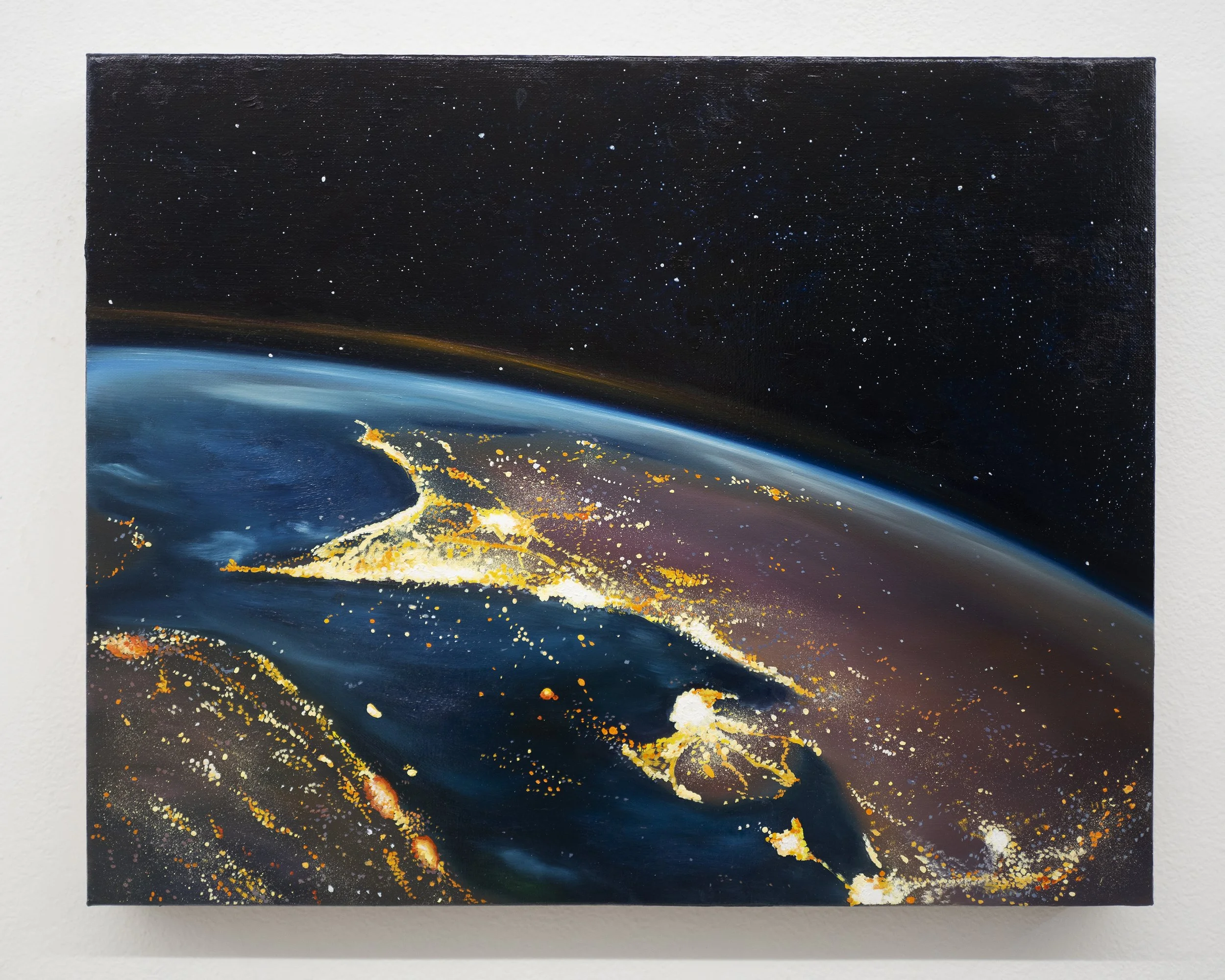
Horizons 02, 2024
Oil on linen
41 x 51 cm (16 x 20 in)


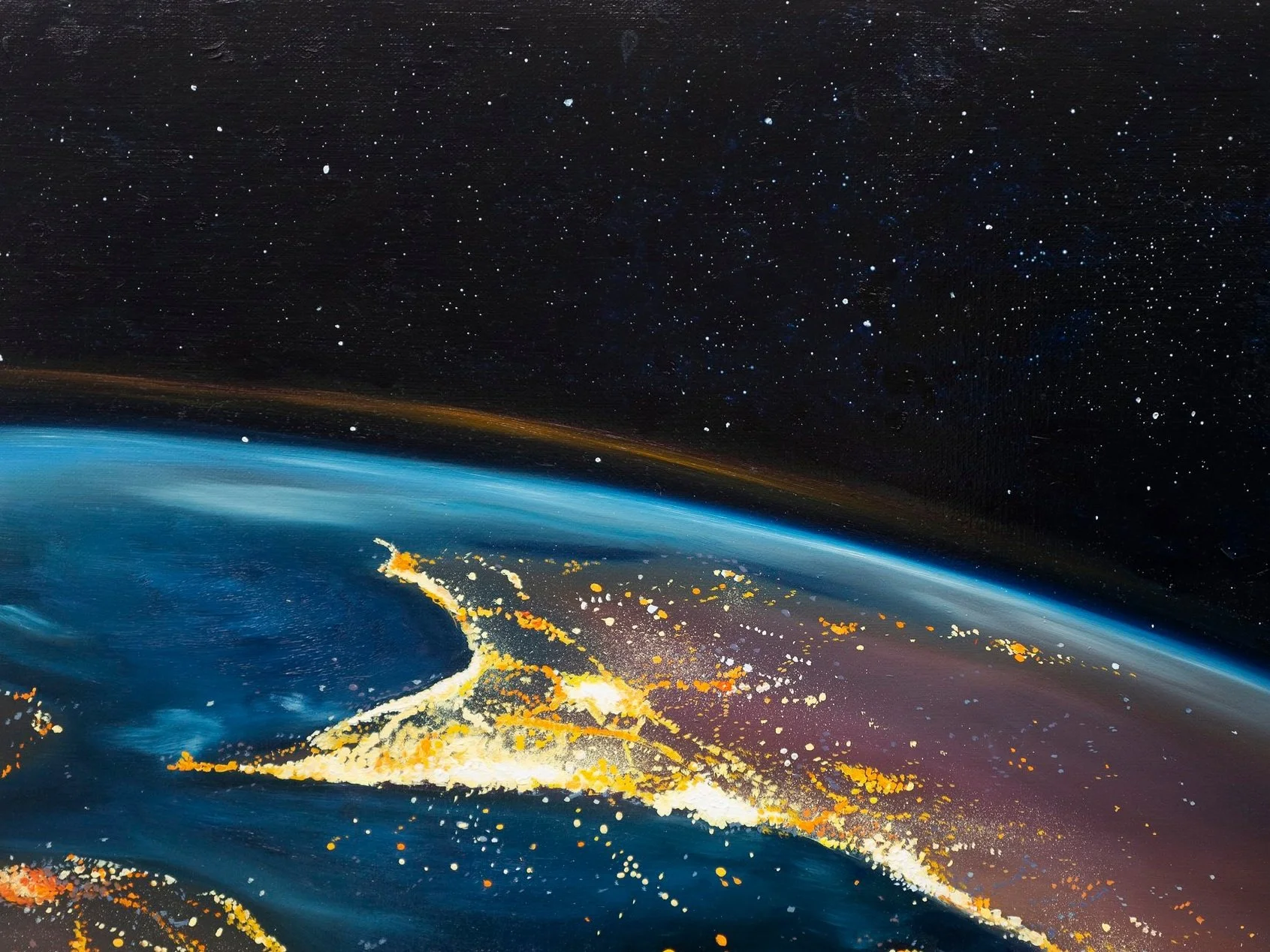
Horizons draws inspiration from the International Space Station, offering a transformative perspective on humanity and Earth. The series captures the radiant lights of megacities and the dreamlike reflections of Earth’s atmosphere, symbolizing the beauty of human civilization. These interwoven lights and shadows highlight the profound impact of technology on how we perceive the world. Tan Mu explores the potential of technology to expand visual boundaries, particularly through real-time transmissions from space that allow humanity to observe Earth from a cosmic vantage point. This “panoramic gaze,” enabled by technology, fosters collective awareness and redefines landscape art, offering a cosmic-scale reexamination of human existence. When the perspective rises above the horizon, a vast sense of peace emerges, inviting humanity to reimagine its place and potential within a connected world. Through layers of oil on linen, Tan Mu translates this cosmic perspective into a tangible visual language. The horizon becomes a dynamic interplay of color and form, evoking depth and expansiveness. Subtle shifts in tone and texture mirror the fluidity of time and space, capturing moments of transition—dawn, dusk, or the infinite calm of a still sea. At its heart, Horizons reflects Tan Mu’s fascination with universal structures and shared human experiences. It reminds us that in the immensity of the cosmos, our shared humanity is both fragile and profoundly connected.

Q: What inspired you to explore the satellite perspective in Horizons, and how were you personally drawn to this unique way of seeing the world?
Tan Mu: From a young age, I was deeply drawn to the sky and to ways of seeing that extend beyond everyday human experience. My maternal grandfather was a meteorologist, and through him I was introduced early on to the relationship between natural systems and technological observation. He taught me how to read weather patterns, understand atmospheric movement, and observe the earth from an analytical distance. These early lessons planted the foundation for my fascination with elevated perspectives and the idea that technology can reveal hidden structures in the world.
Later, during my time at Alfred University, I lived near the Stull Observatory and had access to telescopes. I took astronomy courses and spent many nights observing the sky. The first time I saw the moon through a telescope was a profound moment for me. It fundamentally shifted my perception of scale and distance, and it altered how I understood humanity’s position within the universe. These experiences collectively led me toward the satellite perspective. It is a way of seeing that surpasses the horizon, offering a shared, planetary view of Earth. Through Horizons, I wanted to translate that sense of awe and expanded perception into painting, inviting viewers to reflect on our place within a vast and interconnected world.
Q: Technology plays a significant role in enabling the perspective seen in Horizons. How do you see the relationship between technology, art, and human perception evolving in your work?
Tan Mu: In Horizons, the satellite perspective reflects my understanding of technology as an extension of the body and an external form of memory. Viewing Earth from above is not merely a visual experience. It represents a collective perspective that transcends individual perception. Technology functions as a prosthetic for human vision, allowing us to see beyond biological limitations and access viewpoints that were once impossible.
Through microscopes, we can observe cells, DNA, and atomic structures. Through satellites and telescopes, we can see continents, oceans, and the curvature of Earth. These tools expand perception in both microscopic and cosmic directions, reshaping how we understand life, scale, and interconnectedness. In my practice, technology is not simply an instrument. It becomes a bridge that connects memory, vision, and shared experience. It allows knowledge to move beyond the individual and enter a collective visual language. Horizons reflects this evolving relationship, asking how art can translate these expanded perceptions into emotional and human terms.
Q: The horizon in your work becomes a dynamic interplay of color, form, and texture. Could you walk us through your creative process in achieving this sense of depth and expansiveness?
Tan Mu: In Horizons, I begin by adopting an orbital point of view, positioning the Earth as a living surface rather than a distant object. This elevated perspective creates both physical depth and conceptual distance, allowing the planet to be seen as a continuous and interconnected system. I work in layers of oil on linen, gradually building color and texture to reflect atmospheric movement, shifting terrain, and the fluidity of light.
City lights play an important role in this process. They form intricate patterns that resemble neural networks or biological systems, suggesting that human activity mirrors natural structures. These luminous clusters symbolize communication, energy, and collective presence. I use contrasts between warm and cool tones to establish balance. The golden glow of human habitation meets the cool blues of the atmosphere and surrounding space. This contrast allows the work to hold both intimacy and vastness at once. Through this process, I aim to render Earth not as a static image, but as a living and breathing entity suspended within an immense universe.
Q: The concept of the panoramic gaze is central to Horizons. Could you elaborate on how this idea emerged and how it shapes your approach to depicting Earth and humanity in this series?
Tan Mu: The idea of the panoramic gaze developed from my long-term interest in how technological vision transforms human understanding. It began with Peek, where I reinterpreted the first photograph of Earth taken from space in 1946. That image marked the first moment humanity saw its planet from beyond its surface, suspended against the darkness of space. It fundamentally changed how we understand ourselves and our environment.
This moment became the conceptual origin of the Horizons series. The panoramic gaze is made possible by satellite technology, which allows us to observe Earth in real time from outside its atmosphere. In earlier eras, humans relied on star maps and navigation charts to orient themselves. Today, satellite imagery provides a continuous, global view that reshapes how we understand geography, borders, and interconnectedness.
In Horizons, the panoramic gaze allows me to depict Earth as a unified system rather than a fragmented one. It reveals patterns of light, movement, and habitation that transcend political boundaries. This perspective emphasizes shared existence and collective responsibility. The panoramic gaze is not only a visual framework, but also an ethical one. It reminds us of the fragility of our planet and the shared conditions that bind humanity together within an infinite universe.