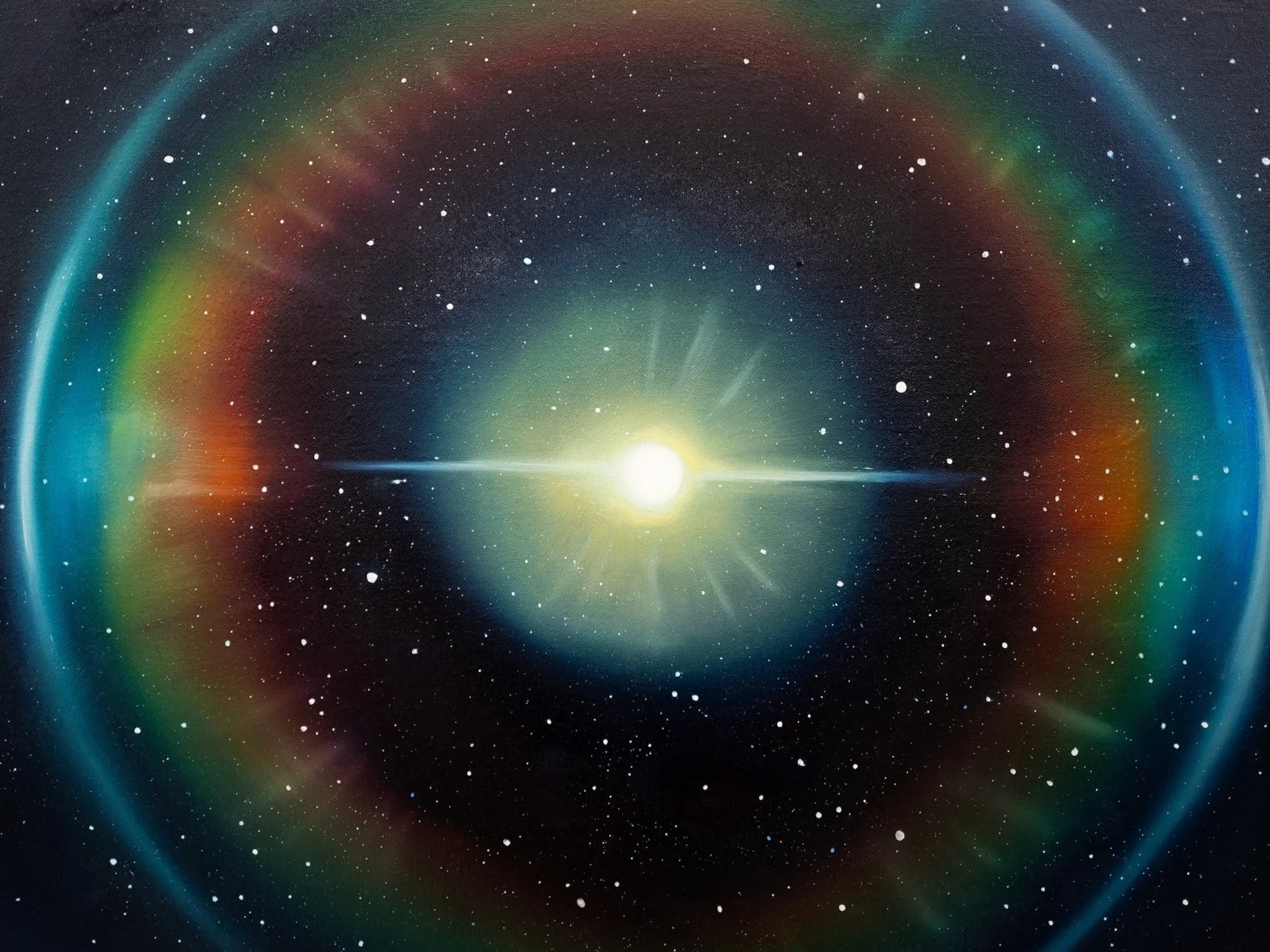
Gaze: Observable Infinity

Gaze: Observable Infinity, 2024
Oil on linen
40 x 55 cm (16 x 22 in)


Observable Infinity (2024) draws from the concept of the “observable universe,” transforming it into an immersive cosmic experience. At its core, the painting features a radiant, circular light resembling an eye—a “cosmic iris”—as though the universe itself is gazing back at the viewer. This focal point is encircled by concentric rings of color, fading gradually into darkness, symbolizing both the visible and hidden realms of existence.
Through symbolic colors and abstract forms, Observable Infinity transcends mere visual representation, guiding viewers into a meditative reflection on our shared existence and the unseen structures that connect us. The vast perspective of the cosmos merges with the intimate image of an eye or a halo of collective light, creating a resonance that evokes a hidden structure of information in both the microcosmic and macrocosmic worlds. Tan Mu bridges the macrocosmic and the personal, offering both a meditation on the universe and an exploration of collective human consciousness.
Light emerges from the depths of unknown darkness, carrying hidden information through the flow of time, soon to be revealed—a moment of revelation that Observable Infinity captures. Blending science, spirituality, and collective memory, this painting embodies reverence for the mysteries of the universe while exploring shared awareness and interconnectedness. It invites viewers to reflect on our role within a larger, interconnected whole.
What inspired Observable Infinity, and how does the symbolism of the eye relate to the idea of the observable universe?
Tan Mu: The starting point for Observable Infinity was a map of the observable universe. When I first encountered it, I was struck by how closely it resembled an iris, as if the universe itself were looking back at us. That moment stayed with me. The observable universe represents only what light has had time to reach us. It is not the whole cosmos, but a boundary shaped by time, distance, and perception. This limitation feels both humbling and poetic.
I wanted to translate that feeling onto the canvas. The eye in Observable Infinity functions as a cosmic iris, a halo of accumulated light that reflects both our individual presence and our shared position within space. It suggests a reciprocal relationship. We observe the universe through technology and science, but at the same time, we exist within it. The eye becomes a bridge between the cosmic scale and personal perception, connecting curiosity, awareness, and the desire to understand something far larger than ourselves.
Can you describe your approach to color and light in this work, and how the process unfolded?
Tan Mu: Color and light were essential in shaping the emotional space of the painting. I worked from the center outward, using warmer tones at the core that gradually transition into cooler hues at the edges. This movement creates a sense of expansion, as if light is radiating into darkness while still holding a concentrated intensity at its center.
The process itself felt surprisingly fluid. The painting came together naturally, without resistance, as though it already knew its form. I began with a smaller scale to test whether this cosmic eye could retain its presence without relying on size. I was surprised by how powerful it felt. Despite its scale, the work holds a strong visual charge. It feels intimate and expansive at the same time, like being met by a gaze that is both distant and immediate.
How does Observable Infinity connect to your broader themes, and what role does technology play in your interpretation of the universe?
Tan Mu: Observable Infinity continues my ongoing exploration of connection, perception, and the relationship between human consciousness and the universe. Technology plays a critical role in this relationship. It extends our senses and allows us to visualize what would otherwise remain inaccessible. Telescopes, satellites, and cosmic mapping tools expand our field of vision while reminding us that what we see is still only a fragment of what exists.
In this work, I wanted to move beyond a purely scientific representation and bring emotion back into the image. Technology and humanity converge here. The painting reflects what we are able to observe, but it also acknowledges the vast unknown that remains beyond our reach. It is a meditation on curiosity and limitation, on knowledge and mystery, and on how technological vision reshapes our understanding of place and scale.
Circular and spherical structures appear throughout your work at different scales. How do these forms resonate with the philosophy behind Observable Infinity?
Tan Mu: From atoms and cells to embryos, MRIs, logic circuits, submarine cables, and now the observable universe, circular and spherical structures appear repeatedly in my work. These forms are not simply visual repetitions. Each one contains information. Embryos carry genetic memory. The brain holds personal experience through neural transmission. Submarine cables store and transmit collective human knowledge and emotion. The observable universe holds the unknown structure of existence itself.
Together, these forms shape what I think of as a universe of concepts. They organize relationships across scales into a spatial system that connects the microscopic and the cosmic. These structures function as containers of memory, data, language, and meaning. Through them, I explore how information moves, how perception is formed, and how human consciousness relates to the hidden frameworks that surround us. Observable Infinity brings this inquiry to its largest scale, while still remaining rooted in the intimacy of seeing and being seen.