
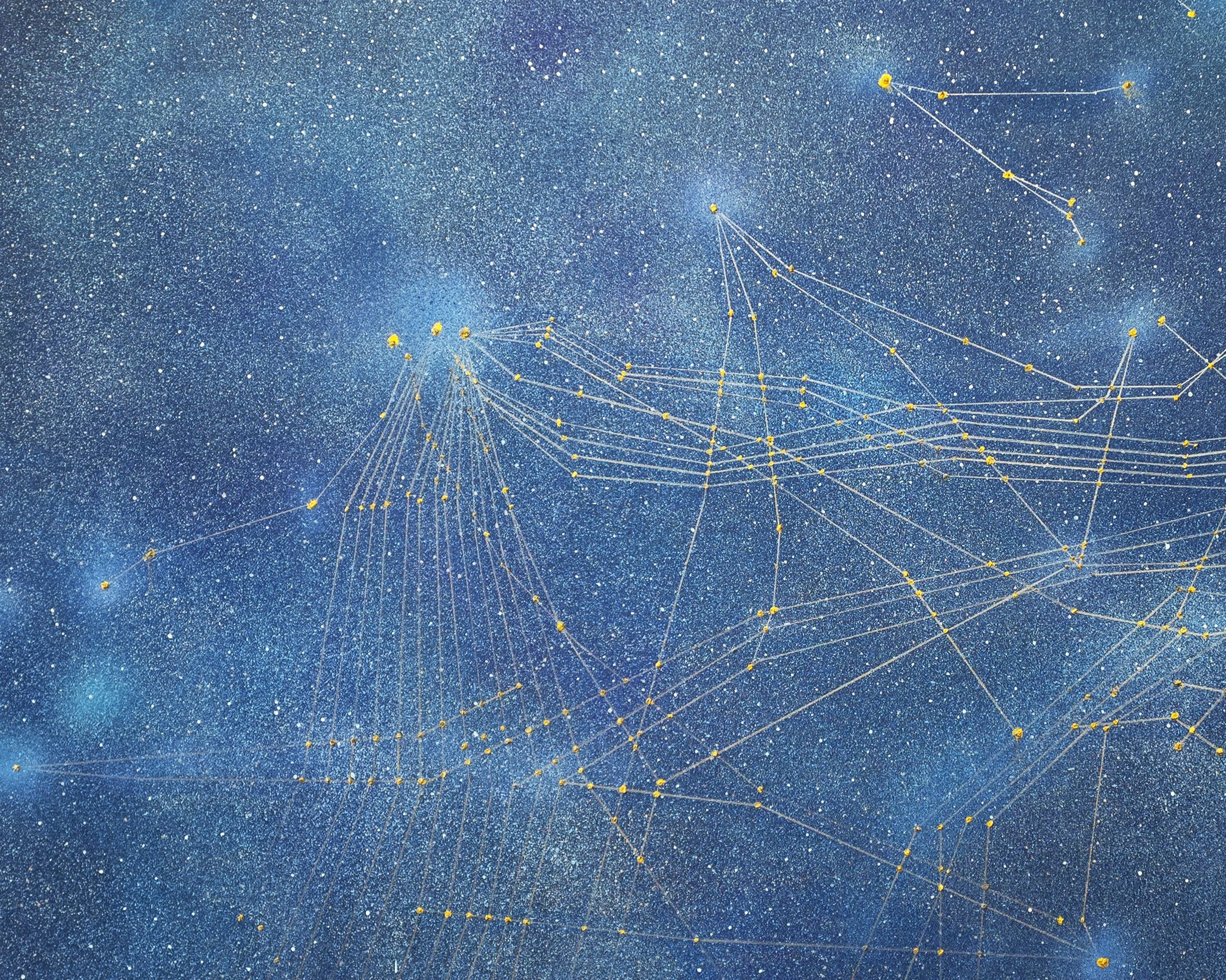
Signal : Submarine Network 02, 2025
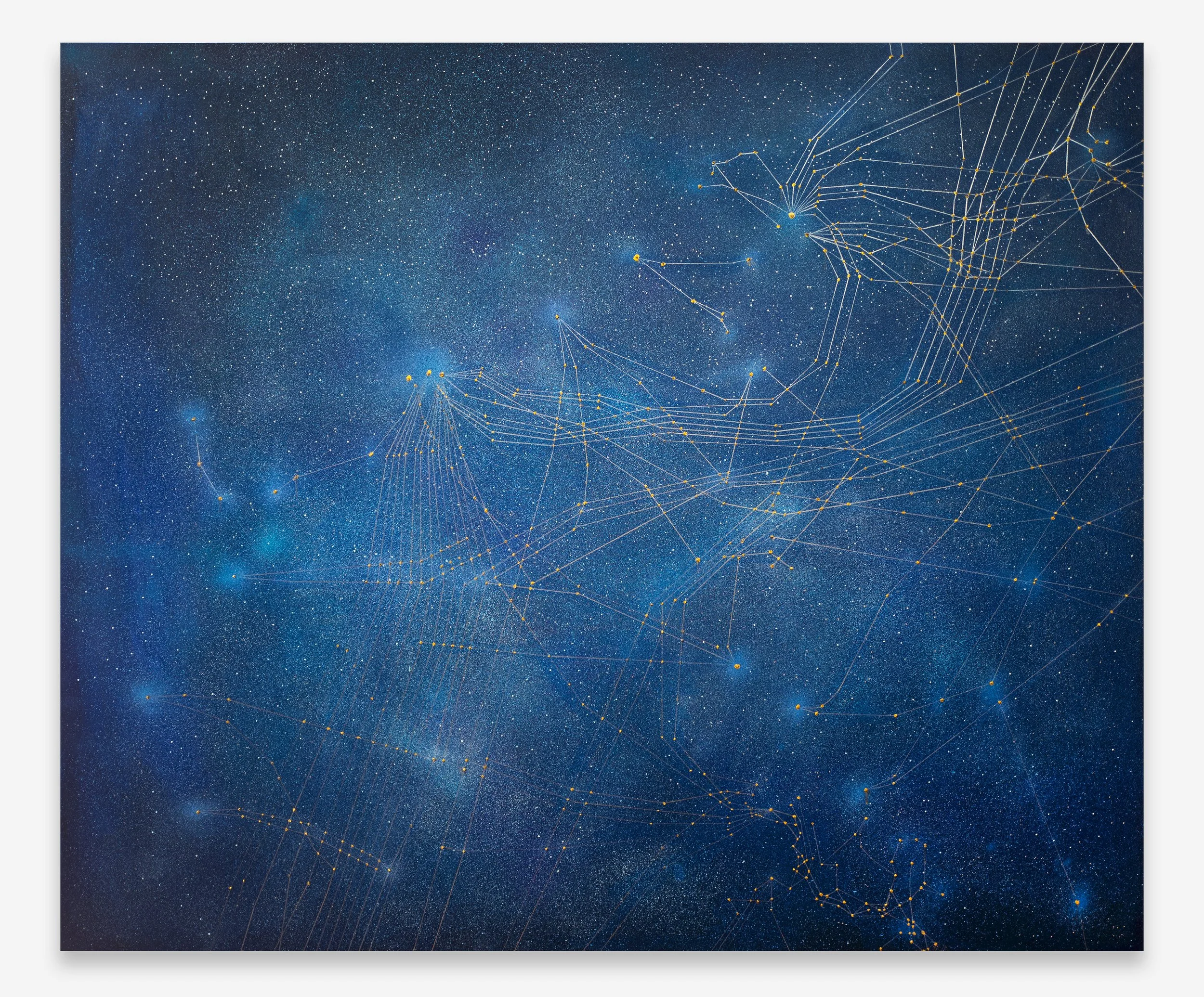
Signal: Submarine Networks 02, 2025
Oil and acrylic on linen
152.5 x 183 cm ( 60 x 72 in)
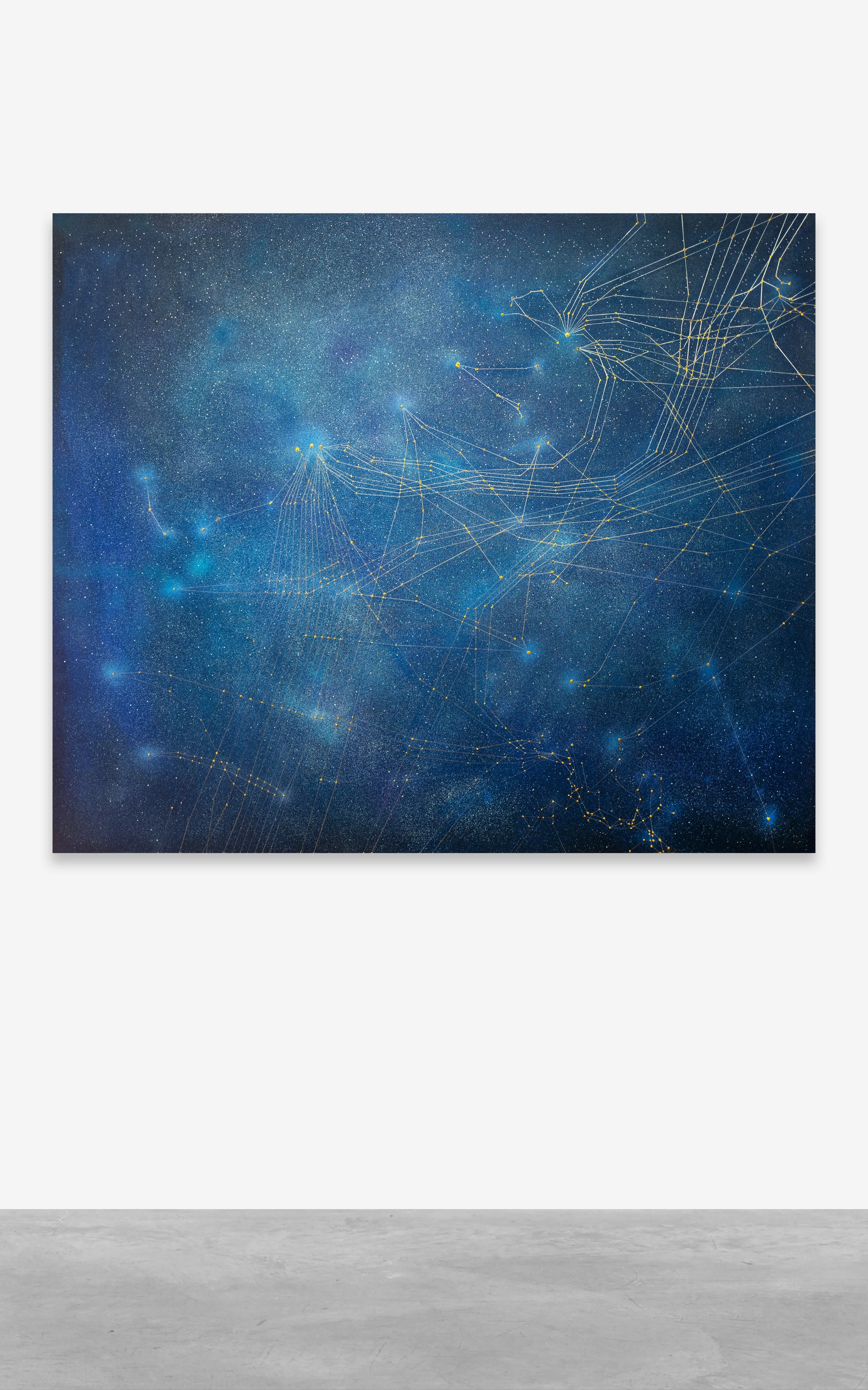
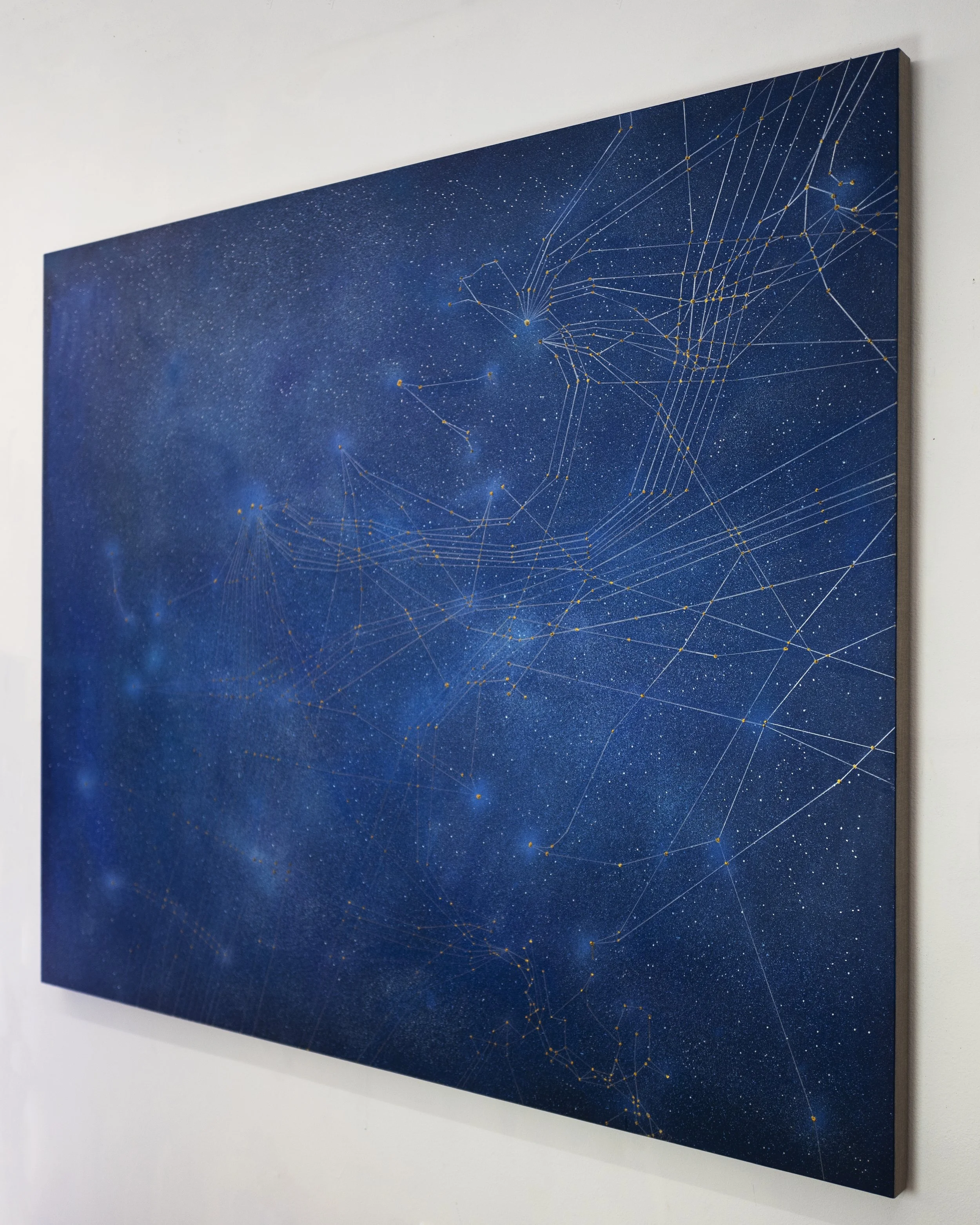
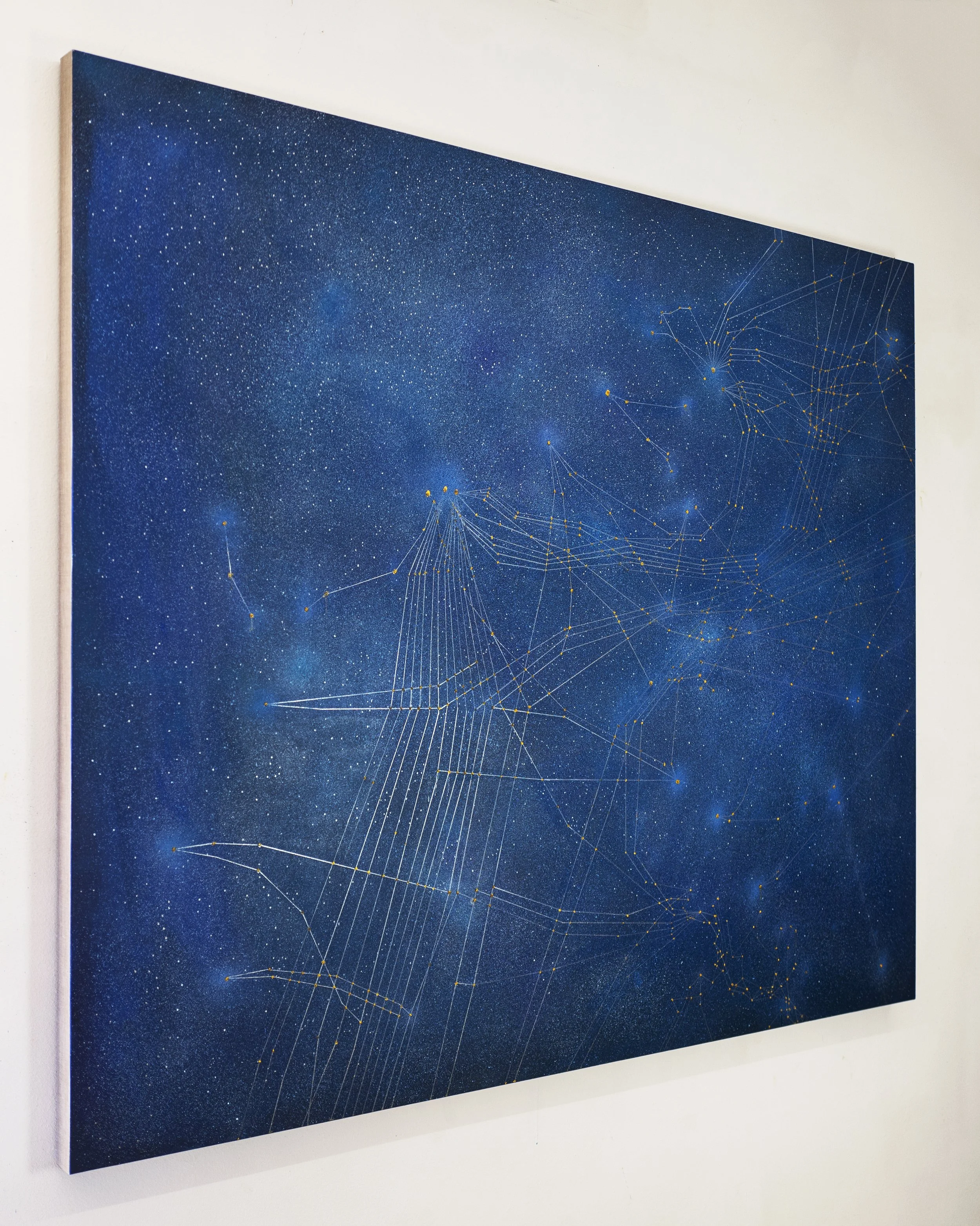
Signal 02 depicts the submarine communication lines spanning the waters from East Asia to Southeast Asia, primarily featuring cable systems such as APCN-2, SeaMeWe-3, and SJC. The artwork highlights the role of these submarine cables in global data transmission. Through an intricate network of lines, it visualizes these hidden infrastructures, exploring how data flows in the digital age connect different regions beneath the ocean's depths.
Tan Mu’s work delves into the hidden networks that sustain and shape our world, from the physical structures of submarine cables to the conceptual geometry of human connection. By uncovering the interplay between structure, data flow, and human emotion, she invites viewers into a meditative reflection on the digital and existential threads that bind us across time, space, and imagination. Her works trace the flow of knowledge and emotional bonds, emphasizing the expanding web of human connection and linking historical narratives to speculative futures.
Earth, our shared home, functions like a vast motherboard, where submarine cables form the invisible pathways connecting supercities. These unseen networks carry humanity’s collective knowledge and emotions, fueling breakthroughs and sustaining our interdependence. Yet, even as we remain tethered to our mother planet, our gaze reaches the stars, seeking guidance and hope in the cosmic expanse.
Signal poetically bridges technology and human sentiment, the interplay between Earth and the cosmos, and the vital role of art in archiving collective memory. Tan Mu arranges abstract dots to form a "digital constellation," where the connections between nodes and cables merge cosmic vastness with oceanic depth. Each dot symbolizes a digital node and a trace of "white noise," embodying the subtle, continuous flow of data and human connection. For Mu, technology is not merely functional; it is an extension of the body and an externalization of memory. Her works trace the flows of knowledge and emotion across oceans, emphasizing the expanding web of human connection while linking historical narratives to speculative futures.
Inspired by The Classic of Mountains and Seas, an ancient text mapping the mythical and the unknown, Signal transforms the unseen digital networks of our era into a contemporary narrative. Like ancient chroniclers who charted mystical landscapes, Signal explores the uncharted digital world, blending the poetic mythology of starry constellations with the tangible structure of global connectivity.
As an ongoing project, Signal evolves over time, embodying the fluidity of the digital age and recording the technological and emotional timestamps of our era. It captures the duality of connection and isolation, exploring how humanity navigates an increasingly interconnected yet fragile world. At its core, Signal preserves the ineffable—our shared memories, dreams, and aspirations—offering a contemplative space to imagine new futures while grounding us in the rhythms of our collective past.



Q: What sparked your deep interest in the ocean?
Tan Mu:My relationship with the ocean began very early. I grew up by the sea, and it was always part of my daily life. My mother was a professional windsurfer, so I spent much of my childhood sailing and observing the movement of wind and water. My grandfather was a marine engineer who worked on large-scale coastal projects such as port design and land reclamation. Through him, I was exposed to marine maps, technical drawings, and engineering plans that revealed the ocean not only as a natural force but as a complex, constructed environment shaped by human systems.
As a diver, the ocean offers another kind of experience. When you reach neutral buoyancy underwater, there is a moment of suspension that feels completely detached from gravity and time. The surrounding marine life begins to resemble stars, drifting through space. The ocean, for me, is both a physical environment and a carrier of memory. It holds layers of personal history, collective experience, and hidden structures, all of which eventually became central to the Signal series.
Q: How did this fascination with the ocean evolve into the Signal series?
Tan Mu:The Signal series began with my 2022 painting Eruption, which responded to the volcanic eruption in Tonga. As a free diving enthusiast, Tonga had always held a special place in my imagination. When the Hunga Tonga-Hunga Ha’apai eruption damaged the submarine cables and cut the country off from global communication, I became aware, for the first time, of how dependent modern society is on these underwater systems rather than satellites.
When communication was restored weeks later, I began Eruption as a way to document reconnection. That experience shifted my focus from a single event to the infrastructure itself. In Twenty Thousand Leagues Under the Sea (2023), I began examining the physical structure of submarine cables, focusing on their cross-sections and material composition. Over time, these cables became more than technical objects. They became metaphors for global connection, memory transmission, and emotional exchange. The Signal series grew from this realization and became an ongoing project that explores how technology quietly carries human relationships across the planet.
Q: Why did you begin the series with the Northwest Pacific region?
Tan Mu:The Northwest Pacific was a natural starting point because it includes my hometown. Beginning there allowed the project to grow outward from something personal rather than abstract. The cable networks in this region connect East Asia, South Korea, and Japan, forming one of the most densely connected zones in the world.
From this starting point, the series gradually expanded to other regions, including waters near Hong Kong and Dubai. Each painting introduces a new geographic and emotional layer, slowly mapping a global network that mirrors both technological systems and lived experience.
Q: How does the series reflect your interest in hidden structures and invisible connections? You often describe this network as an extension of the body.
Tan Mu:I have always been drawn to systems that operate quietly beneath the surface. Submarine cables are invisible, yet they sustain nearly every aspect of contemporary life. I often think of them as the veins of the planet, similar to meridian lines in traditional medicine, circulating energy and information through a living body.
This idea connects directly to my earlier work on the brain and memory. Internal systems such as neurons and synapses transmit thought and emotion within the body, while external systems like cables and data centers extend that process outward into the world. Together, they form a larger body that connects individuals across space and time. The Signal series visualizes this extended anatomy and reminds us that connection is both biological and technological.
Q: You often compare submarine cable networks to constellations. How did this association emerge?
Tan Mu:When visualized on maps, submarine cable networks resemble star charts. Points and lines stretch across vast distances, forming patterns that echo constellations. This visual similarity became meaningful to me.
Historically, humans used stars to navigate unknown territory. Today, submarine cables guide information instead of ships. They are contemporary constellations, mapping human movement, communication, and desire. This parallel allows the series to link the micro and macro, from individual data packets to planetary systems.
Q: The Signal series often merges the ocean and the night sky into a single visual field. How did you develop this language?
Tan Mu:This perspective comes directly from diving. When you are underwater and look upward, the surface of the ocean reflects light in a way that resembles the night sky. In that moment, sea and sky collapse into a single plane.
In the paintings, dots and lines function on multiple levels. They represent data flowing through cables, but they also evoke stars, pixels, and visual noise. This ambiguity allows the work to move between abstraction and figuration. The dots suggest both structure and randomness, order and drift. By merging these elements, I wanted to transform technical infrastructure into something poetic and human, turning cold systems into collective memory.
Q: How does the Signal series connect technology, human experience, time, and labor?
Tan Mu:Submarine cables are built through immense human effort. Each kilometer requires planning, labor, and coordination across nations. Yet the information they carry moves instantly. This contrast between slow construction and rapid transmission is important to me.
In the paintings, each point can be read as data, but also as time, labor, and presence. They acknowledge the human work behind systems we often take for granted. The Signal series is ultimately about coexistence. It reflects how technology, nature, and human effort are inseparable, and how connection is something we continuously build, maintain, and depend on.
If a painting can help someone feel this broader perspective, even briefly, then it has done its work.