Temporal Architectures of Repetition: Signal, Minimal Music, and Systemic Time
Temporal Architectures of Repetition: Signal, Minimal Music, and Systemic Time
Throughout the history of modern and contemporary art, the relationship between abstraction and music has rarely remained at the level of emotional analogy or synesthetic association. Instead, it has formed a methodological dialogue concerning time, structure, and the organization of perception. Beginning with Wassily Kandinsky’s conception of painting as an expression of inner necessity, abstraction gradually disengaged from representational function and redirected its focus toward how form unfolds within time. In this shift, music no longer served as an object of imitation but as a non-narrative organizational paradigm that reoriented viewing away from static imagery toward duration, process, and temporal experience.
By the mid-twentieth century, this structural orientation became systematized within experimental and minimalist music. Composers such as John Cage and Philip Glass displaced melody, thematic development, and expressive climax from the center of composition. Procedures based on repetition, density, interval, and gradual variation transformed musical perception from the anticipation of events into the inhabitation of a system in operation. Music, in this context, ceased to function primarily as a vehicle of emotional expression and instead became a temporal mechanism. It offered an architecture through which time could be organized, sustained, and experienced.
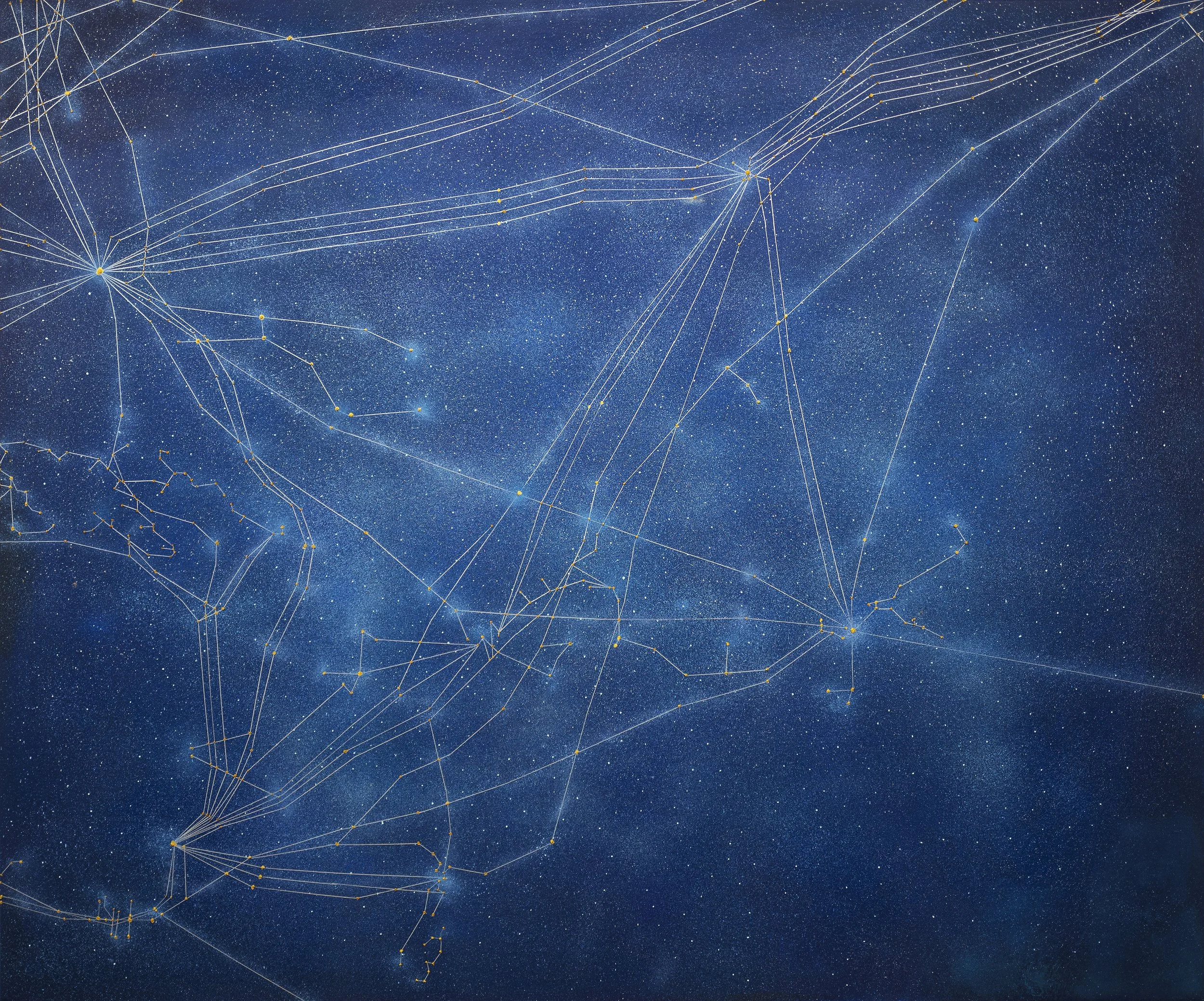
Within this methodological lineage, Tan Mu’s Signal series can be understood as a visual system structurally comparable to Philip Glass’s compositional logic. Signal does not reference music iconographically, nor does it attempt to translate sound into visual form. Rather, it advances abstraction beyond formal language into a systematized temporal structure. Lines, nodes, and pathways operate as functional units that articulate relations of connectivity, transmission, and delay. Meaning emerges through repetition, micro-variation, and sustained temporal engagement rather than symbolic representation.
This visual logic parallels Glass’s use of minimal musical cells and additive processes. Expansive sonic fields in Glass’s work are generated through the accumulation of minute repetitions that gradually produce perceptual shifts. In Signal, finely modulated textures, chromatic oscillations, and layered pathways transform singular visual signals into continuous fields of transmission. Repetition functions as a generative structure through which time is perceived rather than measured.
The temporal logic of Signal is not confined to formal abstraction. Unlike early twentieth-century spiritual abstraction, the series derives its structure from contemporary infrastructural realities. Global communication networks and technical protocols are not treated as autonomous systems but as assemblages sustained through continuous and embodied human labor. Submarine fiber-optic cables are neither neutral nor immaterial. They result from engineers, sailors, and deep-sea divers operating under extreme conditions and inserting human bodies into zones of risk and invisibility. These infrastructures compress histories of labor, maintenance, and exposure into systems that appear seamless and abstract at the surface.
From this perspective, Signal performs a micro-analytic operation on global infrastructure, comparable to decompositional strategies associated with systems aesthetics and post-minimalist practices. The work disassembles technological systems into discrete visual units such as localized signals, interruptions, and connections, making the rhythms of infrastructure perceptible. This decomposition becomes a critical maneuver rather than a simplification, transforming abstract systems of power, circulation, and control into visual frequencies that can be encountered, examined, and temporally inhabited.
Contemporary information systems extend beyond physical infrastructure into distributed human participation. Through acts of uploading, downloading, waiting, buffering, and interruption, individuals become active nodes within global networks. Humans are not external users of technology but essential conditions for its continuous operation. Signal translates this synchronized participation into visual form, reframing the technical concept of the node as a perceptual condition defined by position, responsibility, and relationality within a system.
The affinity with music becomes especially pronounced here. Minimalist music is not produced by a singular expressive subject but through coordinated human activity involving performance, listening, and shared duration. Sound emerges relationally and is sustained by collective presence within a structured temporal field. Signal likewise does not present systems as static representations but activates them through time-based perception.
When installed within a theatrical context, this public dimension intensifies. The theater functions as an institutionalized temporal structure and a space of collective presence. Before a performance begins, Signal operates as a silent visual architecture that functions both as score and as prelude, organizing attention through rhythm without sound. In this suspended interval, submarine infrastructure, distributed digital labor, and the audience’s shared presence converge into a common temporal field that precedes action and already structures perception.
In this sense, Signal transforms abstraction into a public temporal structure. It repositions viewers as participants embedded within systems and renders visible the human labor that sustains technological processes. Rather than depicting systems as images, Signal proposes a model for how abstraction might operate today, as a method for organizing shared time, visibility, and labor within increasingly complex technological environments.