
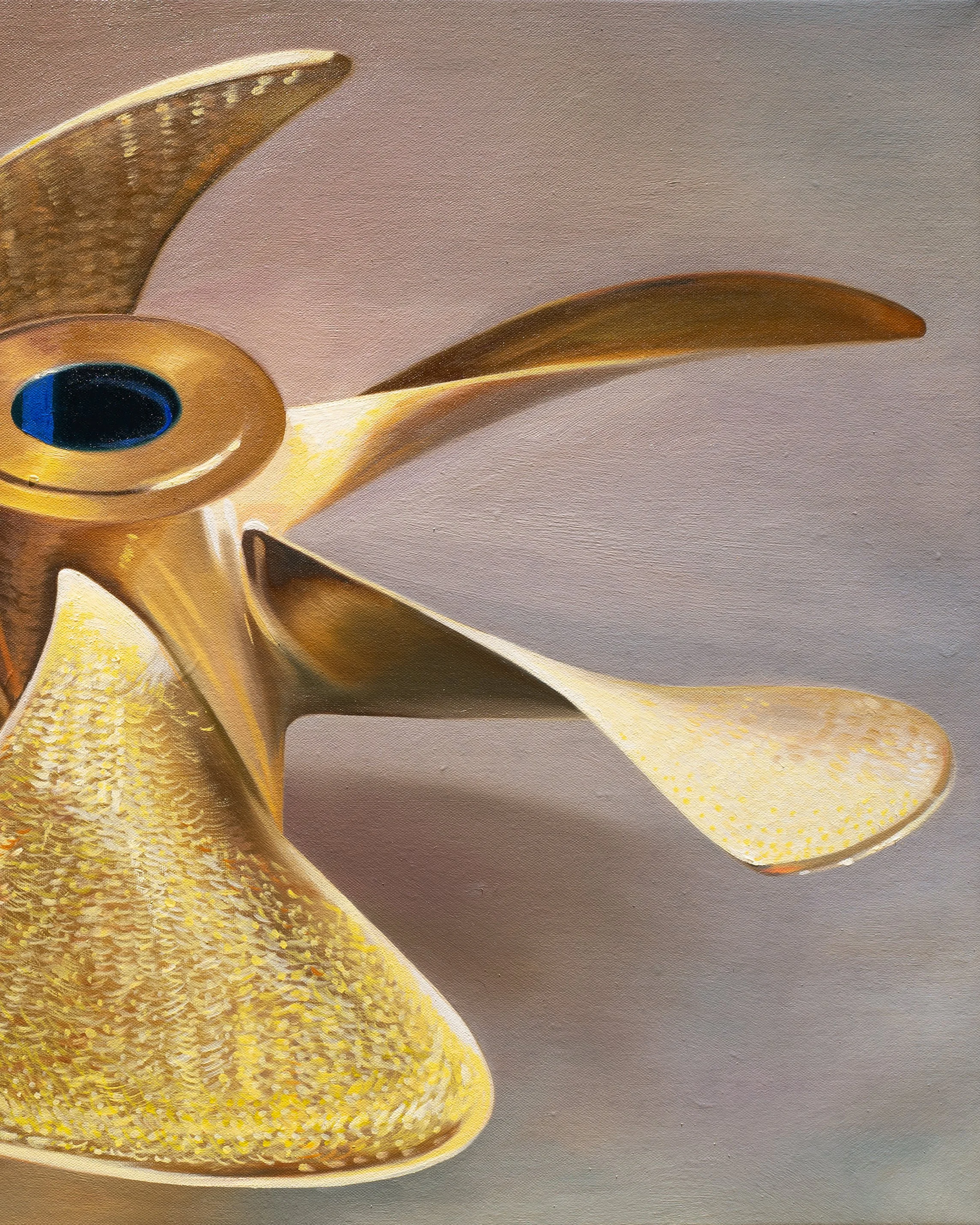
The Wave 03, 2024

The Wave 03, 2024
Oil on linen
51 x 77 cm (20 x 30 in)

The Wave series, inspired by propellers and mechanical technology, delves into the intricate and often unseen forces that propel modern machinery forward. Through these works, Tan Mu examines the mechanics and profound influence of propulsion technology, inviting viewers to contemplate the delicate interplay between human ingenuity and the natural world. In her meticulously crafted oil paintings, Mu captures the essence of the propeller, highlighting its significance as a technological marvel central to maritime transportation and global trade. Beyond their functional importance, the Wave series encourages a deeper reflection on the broader implications of such advancements. It challenges us to reconsider our relationship with nature, recognizing how technological progress shapes and transforms our interactions with marine environments and ecosystems. A visual meditation on innovation and its consequences, the Wave series urges us to appreciate both the beauty and the far-reaching impact of technological evolution in our interconnected world.


Q: Your The Wave series is inspired by propellers and machinery. Could you discuss the background and core concept behind this series?
Tan Mu: Container (2021) was my first work that directly addressed maritime logistics, and The Wave series naturally evolved from that investigation. My interest in maritime transport is also deeply personal. My great-grandfather was a sea merchant during the Nationalist era, traveling between China and Korea and spending much of his life on international waters. Through his stories, I became aware that the ocean is not only a route for goods, but also a carrier of culture, memory, and exchange.
In The Wave, I focus on the ship’s propeller as a symbol of this movement. The propeller represents a convergence of nature and machinery—although it is a mechanical object, its function relies on fluid dynamics, turbulence, and flow. Its motion echoes natural systems such as ocean currents, air circulation, and even biological structures like DNA. This coexistence of mechanical force and natural rhythm is what draws me to the subject. I am interested in moments where technology does not oppose nature, but mirrors it.
Q: The dynamic energy and spiral structure of the propellers are central to this series. Could you expand on this idea?
Tan Mu: As a propeller rotates, it generates vortices and fluctuations in the surrounding water. This kinetic energy is invisible but immense, and I wanted to make it perceptible through painting. I express this movement through circular compositions, flowing lines, and warm golden tones that suggest rotation and momentum.
The spiral or toroidal structure of the propeller connects directly to forms that recur throughout my practice. I have explored similar geometries in works such as Torus (2020–2021), the Gaze series, and paintings of cells, atoms, black holes, and cosmic phenomena. These forms reflect a continuous energy cycle that exists across scales—from the microscopic to the cosmic. In The Wave, the propeller becomes a vessel for this idea, embodying the life force and rhythmic energy that underlies both natural and technological systems.
Q: In the first work of The Wave series, you depict a massive propeller alongside human figures. What was your intention behind this composition?
Tan Mu: This piece was shaped by my interest in globalization and the increasing scale of industrial infrastructure. As global trade has expanded, cargo ships have grown dramatically larger, and so have their propellers. In 1934, the Museum of Modern Art’s Machine Art exhibition displayed propellers that were less than one meter in diameter. Today, some ship propellers can reach diameters of eight meters.
By placing a small human figure beside the propeller, I wanted to emphasize this shift in scale and to acknowledge the labor behind such technological achievements. The figure serves as a point of reference, allowing viewers to physically sense the magnitude of the machine. In this way, the painting becomes both a document of technological progress and a reflection on the human effort embedded within it.
Q: Gold plays a prominent symbolic role in this series. What does it represent for you?
Tan Mu: Gold is not simply a visual choice—it carries symbolic weight. Historically, gold has been associated with reverence, power, and devotion. In The Wave, I use gold to render the polished surface of the propeller, transforming it into an object that feels almost sacred.
I see this as a reflection of how contemporary society venerates technology. Today, devices such as quantum computers, massive turbines, particle accelerators, and microchips inspire awe in ways that once belonged to religious or mythological objects. By using gold, I draw a parallel between ancient totemic worship and modern technological reverence, suggesting that while the objects of devotion may change, the human impulse to worship progress remains constant.
Q: Beyond The Wave series, how does this work connect to your broader exploration of ocean-related technologies?
Tan Mu: The ocean has become a recurring site in my practice. From Container (2021) to the ongoing Signal series, I have been exploring maritime infrastructures that quietly sustain global systems. The Signal series focuses on undersea fiber-optic cables—hidden networks that enable global communication and data transmission.
In The Wave, the ship’s propeller represents the physical movement of goods, while the cables in Signal represent the invisible movement of information. Together, they form the foundation of globalization. Both systems operate beneath the surface, out of sight, yet they profoundly shape our lives. Through these works, I’m interested in how technology extends human connection—carrying not only materials and data, but also memory, emotion, and shared experience across vast distances.

Machine Art, 5 March to 29 April 1934