
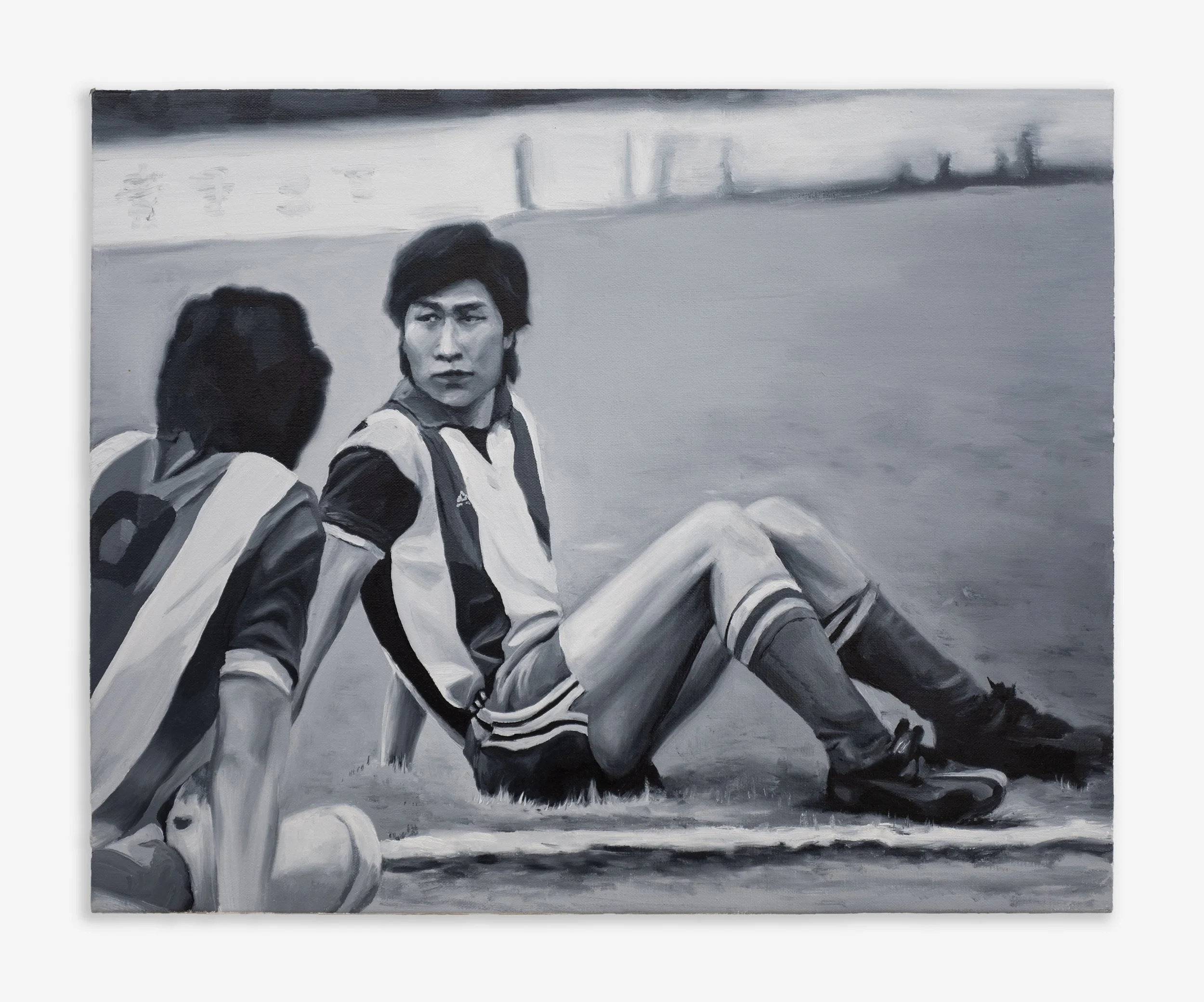
Turf, 2021
Turf, 2021
Oil on linen
41 x 51 cm (16 x 20 in)

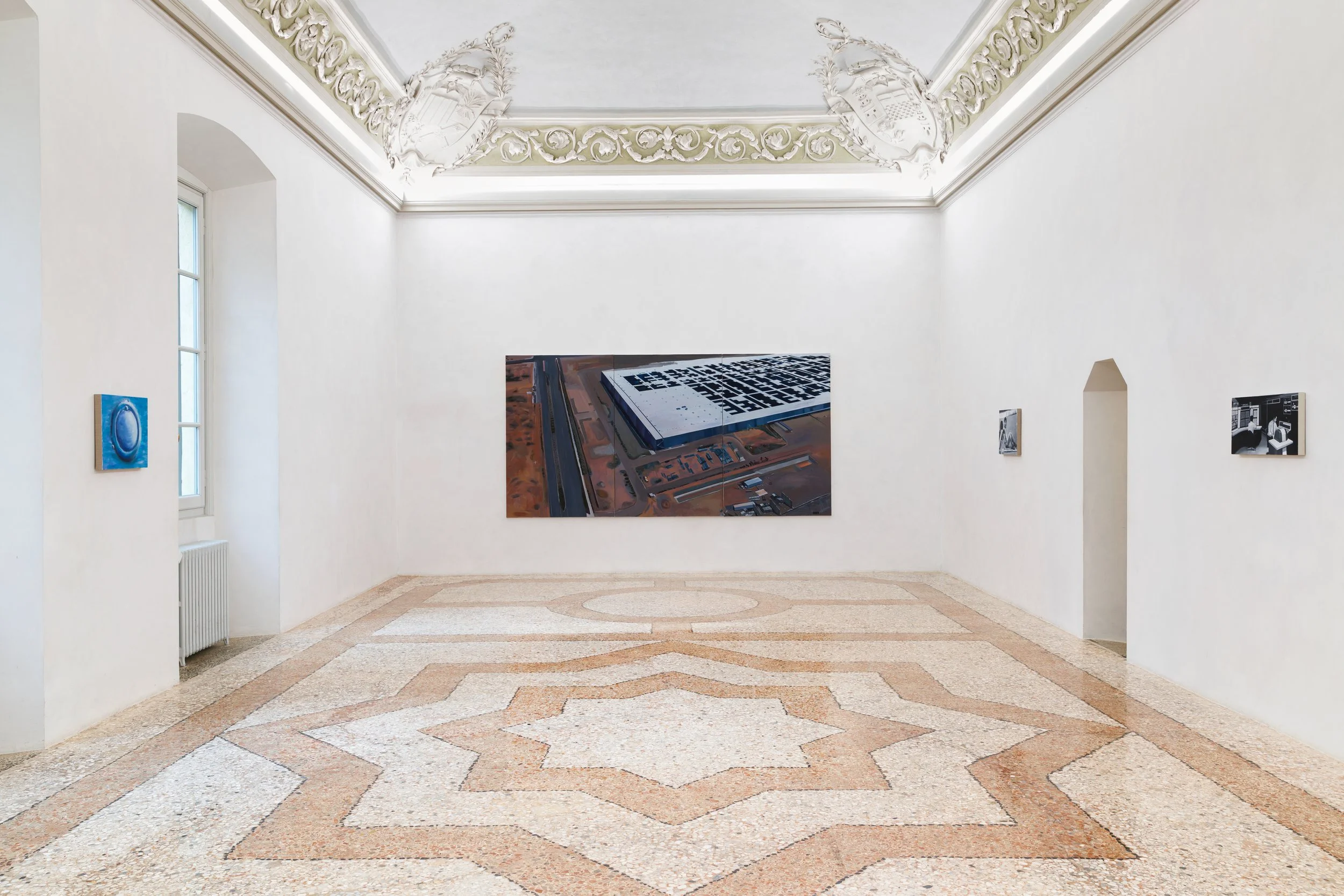
Signal, May 5 – June 10, 2022, Peres Projects, Milan
Signal, May 5 – June 10, 2022, Peres Projects, Milan
The work Turf (2021) reflects Tan Mu’s origin story in many ways. The seated young man depicted in the painting is her father, a professional soccer player in the 1980s who chose to retire upon the artist’s birth. A photograph of him was featured in sports news, serving as a tangible record of an unwitnessed past—a “family photo” that exists outside personal memory and even beyond the family album. In response, Mu sought to document this memory through painting. Turf also explores the positioning of the self within the universe, the intersection of heritage and future, familial lineage, and the trajectory of technoscientific progress.
Q: Turf is one of your more figurative and personal works. What drew you to return to this specific image?
Tan Mu: Turf originates from a photograph of my father taken during his career as a professional soccer player in the 1980s. That image existed publicly, circulated through sports media, yet it was never something I personally witnessed. In that sense, it functions as a kind of inherited memory rather than a lived one. I was drawn to this image because it sits between private family history and public documentation. Painting it became a way to enter a moment that predates my own consciousness and to reconstruct a personal origin through an external record. The work reflects how identity can be formed not only through experience, but through images that exist outside of memory, yet still shape who we are.
Q: How does the use of black-and-white imagery affect the emotional and conceptual tone of the painting?
Tan Mu: The black-and-white palette removes the image from a specific moment in time and places it into a more reflective, suspended space. It echoes the language of archival photography and historical documentation, reinforcing the idea that this is a moment retrieved rather than remembered. Without color, the focus shifts to posture, gesture, and atmosphere. The absence of color also mirrors the distance between myself and the event depicted. It is not nostalgia in a sentimental sense, but a reconstruction of memory through mediation. The monochrome language allows the painting to exist between past and present, personal history and collective record.
Q: Turf appears quieter than many of your technologically driven works. How does it connect to your broader practice?
Tan Mu: While Turf may appear more intimate, it is deeply connected to my broader exploration of time, transmission, and systems of record. Just as satellites, data centers, or containers carry information across space, this photograph carried a piece of my family history across time. The soccer field becomes a stage where lineage, choice, and trajectory intersect. My father’s decision to retire coincided with my birth, linking personal life decisions with generational transition. In this sense, Turf is not separate from my interest in technoscientific progress. It asks similar questions about how moments are preserved, how identity is transmitted, and how individual lives are situated within larger historical systems.