About
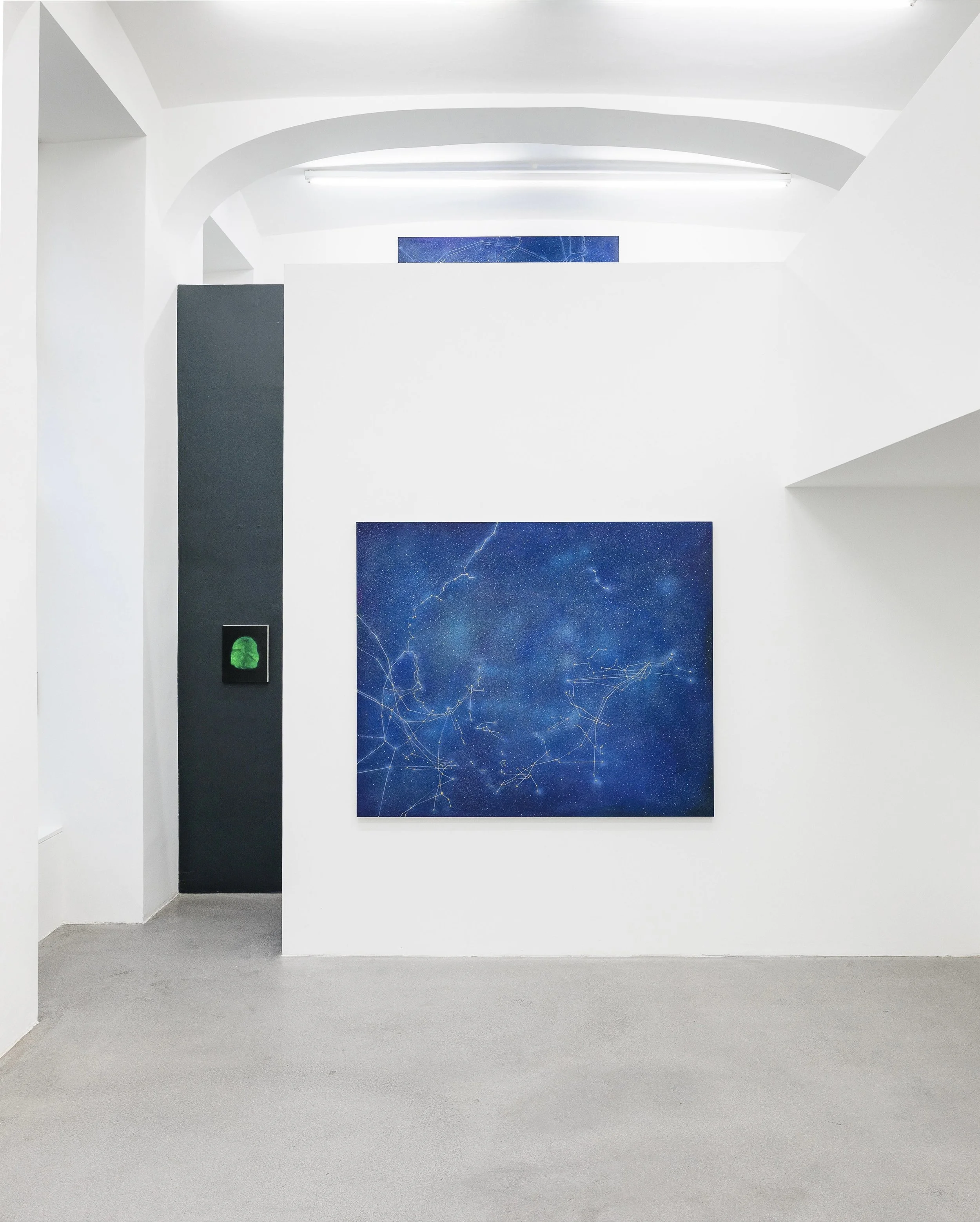
Installation View: Signal and Beyond
September 2- November 15, 2025
BEK Forum, Vienna, Austria
Tan Mu (b. Shandong, China; lives and works in Paris) is a contemporary artist whose practice transforms invisible structures, planetary scales, and technological systems into perceptual and embodied experience.
She grew up along the coast of Shandong, where early encounters with the sea shaped a lasting attentiveness to forces operating beneath visible surfaces, including bathymetric maps, maritime infrastructures, signal routes, and environmental conditions that structure the world without being directly seen. This attentiveness has since extended into freediving, where descending on a single breath alters perception, pressure, orientation, and the experience of time itself.
When reality becomes too vast or too complex for direct perception, humans begin to paint. From prehistoric cave walls to the present, painting has remained a way of giving form to forces that cannot otherwise be grasped. It is within this expanded understanding of painting that Tan Mu works.
Trained first in painting at the Central Academy of Fine Arts in Beijing, and later in expanded media at Alfred University in New York, she brings together two traditions that rarely converge. One is rooted in surface, material, and restraint. The other emerges through signal, systems, and technological perception. Encounters with programming and sensor-based environments introduced ways of understanding reality as dynamic fields of interaction, feedback, and transmission, not as static objects, but as conditions in constant flux. These experiences continue to shape a practice grounded in perception, spatial relation, and translation.
Across series such as Signal, Glacier, Quantum, Horizons, and Moon, Tan Mu transforms infrastructures, geological processes, and cosmic viewpoints into visual fields where macro and micro scales coexist. Submarine cables become emotional and neural maps. Ice becomes a recording system for planetary time. Scientific apparatuses become instruments of expanded perception. Horizons emerge as cognitive boundaries rather than fixed lines. This approach is particularly visible in the ongoing Signal series, which examines global communication through submarine fiber optic infrastructures. Systems that usually remain abstract or inaccessible are reconfigured as visual fields moving between structure and sensation.
Underlying the work is an evolving atlas that brings together research, archival material, field observation, scientific imagery, and painting. Rather than functioning as a fixed database, the atlas operates as a relational structure through which references, environments, and scales connect across time. Within this logic, painting becomes less a matter of representation than of orientation and mapping. Diagrams, technical images, and observational references are gradually absorbed into the painting process, where they are transformed rather than reproduced.
Working with oil, acrylic, and linen, Tan Mu approaches the painted surface as a material and perceptual interface where layering, luminosity, and scale function as active conditions.
Tan Mu received her BFA in Expanded Media from Alfred University, New York (2015), and previously studied at the Central Academy of Fine Arts, Beijing (2011).
Her work has been exhibited internationally, with solo exhibitions at Peres Projects, Berlin (2022) and Milan (2022), and BEK Forum, Vienna (2025). Group exhibitions include ERES Foundation, Munich; Ruttkowski;68, Paris; Tang Contemporary, Beijing; Rusha & Co, Los Angeles (2026); Arario Gallery, Shanghai (2025); Penske Projects, New York; Winter Street Gallery, Martha's Vineyard (2024); and YveYANG, New York (2023).
Her work is held in major public and institutional collections, including The Dubai Collection; the Carmen Thyssen-Bornemisza Collection; the Utah Museum of Fine Arts; the Institute for Electronic Arts; the Central Academy of Fine Arts Collection; and the Alfred School of Art and Design Collection.
Full CV and portfolio upon request at tan@tanmustudio.com
For institutional inquiries, curatorial collaborations, publications, and project proposals, please contact Nick Koenigsknecht, who works closely with the artist on the development of projects, exhibitions, and writing. nick@openforum.info