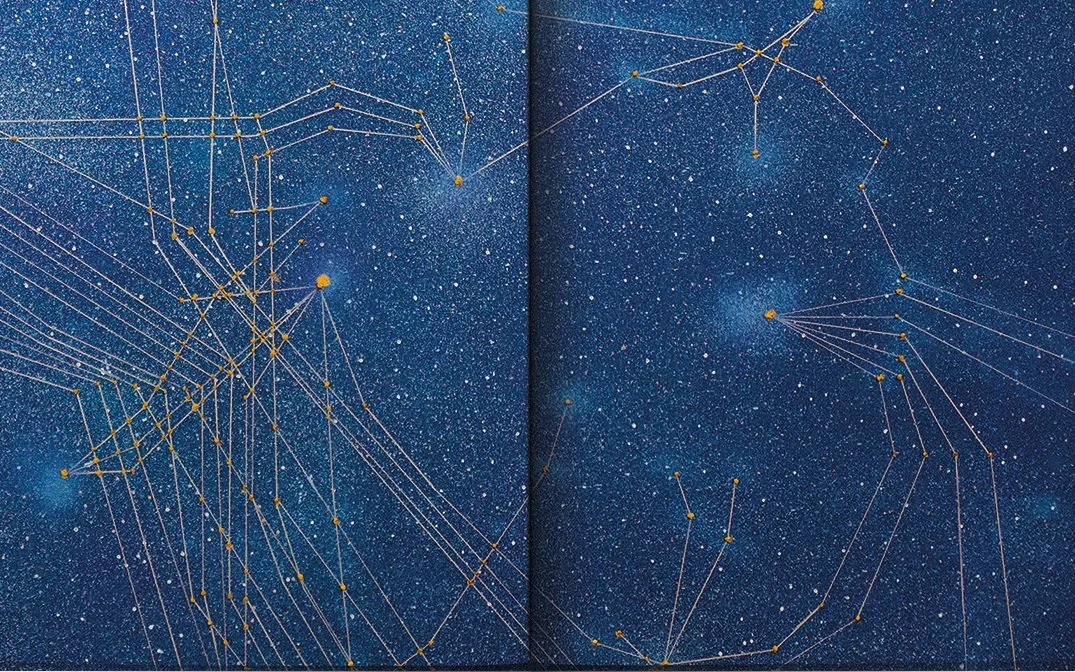
Atlas of seeing
Atlas of Seeing
May 8th, 2026
I began this body of work with a simple tension. We live inside systems that shape perception, yet most of those systems remain unseen. Data moves, signals travel, images circulate, and decisions are made through infrastructures that sit beneath the surface of daily life. I paint because painting slows the world down enough for me to study what usually passes too quickly to notice.
My practice is research driven. I work with painting the way others work with field notes or instruments. I look through microscopes, study satellite imagery, and borrow from scientific visualization, not to illustrate science, but to learn how contemporary vision is constructed. These tools extend my senses outward, but they also reveal a limit. The more we rely on instruments, the more we realize that seeing is never neutral. Seeing is shaped by scale, by compression, by translation, by the interfaces that decide what counts as visible.
Many of the images in this book move between the biological, the computational, and the cosmic. Neurons, embryos, logic circuits, quantum machines, cable cross sections, celestial bodies. These are not separate subjects to me. They are different registers of the same question: how structure becomes experience. I think of technology as an extension of the body and as a form of externalized memory. It stores, transmits, and reorganizes our lives, then it returns to us as sensation, anxiety, intimacy, and distance.
The Signal series is one place where these ideas concentrate. I have spent years engaging with submarine fiber optic networks, the hidden architectures of global communication. Cables on the seafloor are physical, heavy, and vulnerable. Yet they carry the immaterial feeling of connection. They hold histories and economies, migrations and relationships, and the fragile promise that we can reach one another through distance. In my work, these networks appear as digital constellations, diagrams that move between abstraction and representation, between emotion and system. My relationship to this subject is also bodily. I am a freediver. In the water, perception recalibrates. Pressure changes orientation. Silence changes time. A single breath becomes a measure of attention. Freediving taught me that the body is an instrument, but it is also a threshold. It cannot hold everything. It must choose what to keep. That experience shaped how I think about infrastructure, especially the deep sea. Under the ocean, there is darkness, life, energy, and information. There are cables that keep the world speaking to itself. In the studio, I return to that depth as a way to understand connection and disconnection as physical realities, not metaphors.
I have always been drawn to maps and to the idea of an atlas. An atlas does not tell a story. It organizes attention. It allows you to move through fragments without forcing a single conclusion. When I think about ancient atlases and celestial charts, I am struck by how they hold imagination and measurement side by side. The Classic of Mountains and Seas, for example, records geography, myth, and the unknown together. It is a way of seeing that accepts partial knowledge and still insists on form. I return to that poetic logic when I map contemporary systems that are real, vast, and mostly invisible.
This book follows that structure. Each work is presented as its own entry, beginning on a fresh page. You will see an image, then the title, then a description, followed by a short Q and A. The text is not meant to close the work. It is meant to keep the work open. In the studio, I often think by questioning, by testing what I believe I know, by letting a material decision produce a conceptual one, then letting the concept push back. The Q and A format is a trace of that process. It is not a performance of certainty. It is a record of thinking while making.
I am careful about language that claims to reveal. Much of contemporary life is already visible, but not legible. We live with an excess of images and an excess of information. The problem is not that we cannot see. The problem is that we see too much, too quickly, through systems designed to prioritize speed, extraction, and simplification. Painting, for me, is a practice of delay. It holds a fragment long enough for complexity to return. It makes time for ambiguity, for contradiction, for the feeling that something matters even when it cannot be fully named.
White space is part of this method. Space is not decoration. Space is the condition for recalibration. In a gallery, the distance between works changes how the work is received. In a book, the blank areas around an image or a paragraph give the viewer room to register scale, texture, and breath. This is why the pacing here is intentional. Each entry stands apart, and the intervals are preserved.
The works in the Atlas of Seeing are grounded in material decisions. Oil, linen, surface tension, layering, repetition, constraint. I am interested in how systems operate through rules and thresholds, and also in how systems fail, how noise enters, and how unpredictability becomes visible. I do not treat these moments as mistakes. They are often the most honest points in the work. They show where control ends and where perception begins.
I do not expect a linear reading. An atlas can be opened anywhere. You can enter through a single work, move forward, move backward, pause, and return. The meaning does not sit inside one image. It emerges across relationships, across distances, across repeated structures that shift each time slightly. The book is a field of signals. Some are clear. Some are weak. Some are interference. All of them are part of the same atmosphere.
If there is a belief underneath these works, it is that seeing is an active negotiation. It involves memory, expectation, and the limits of the frame. It is shaped by the tools we use, and by the environments we inhabit, and by the pressures we endure. This atlas is not a claim to completeness. It is a record of attention, offered as a working document.
I am mapping what I can, knowing the map will always be incomplete. That incompleteness is not a failure. It is a condition of contemporary perception. It is also the reason I continue.