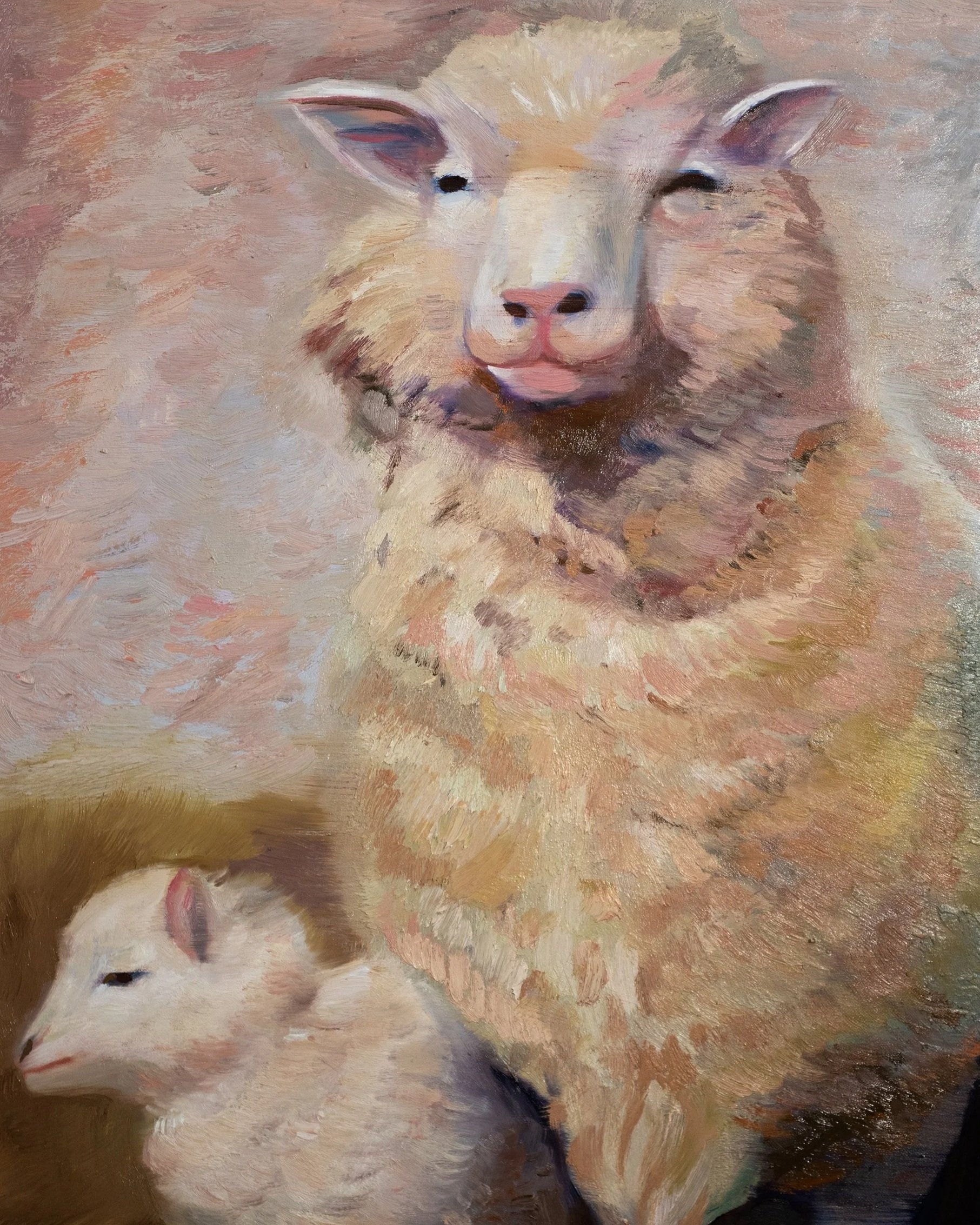
Dolly and Bonnie, 2026
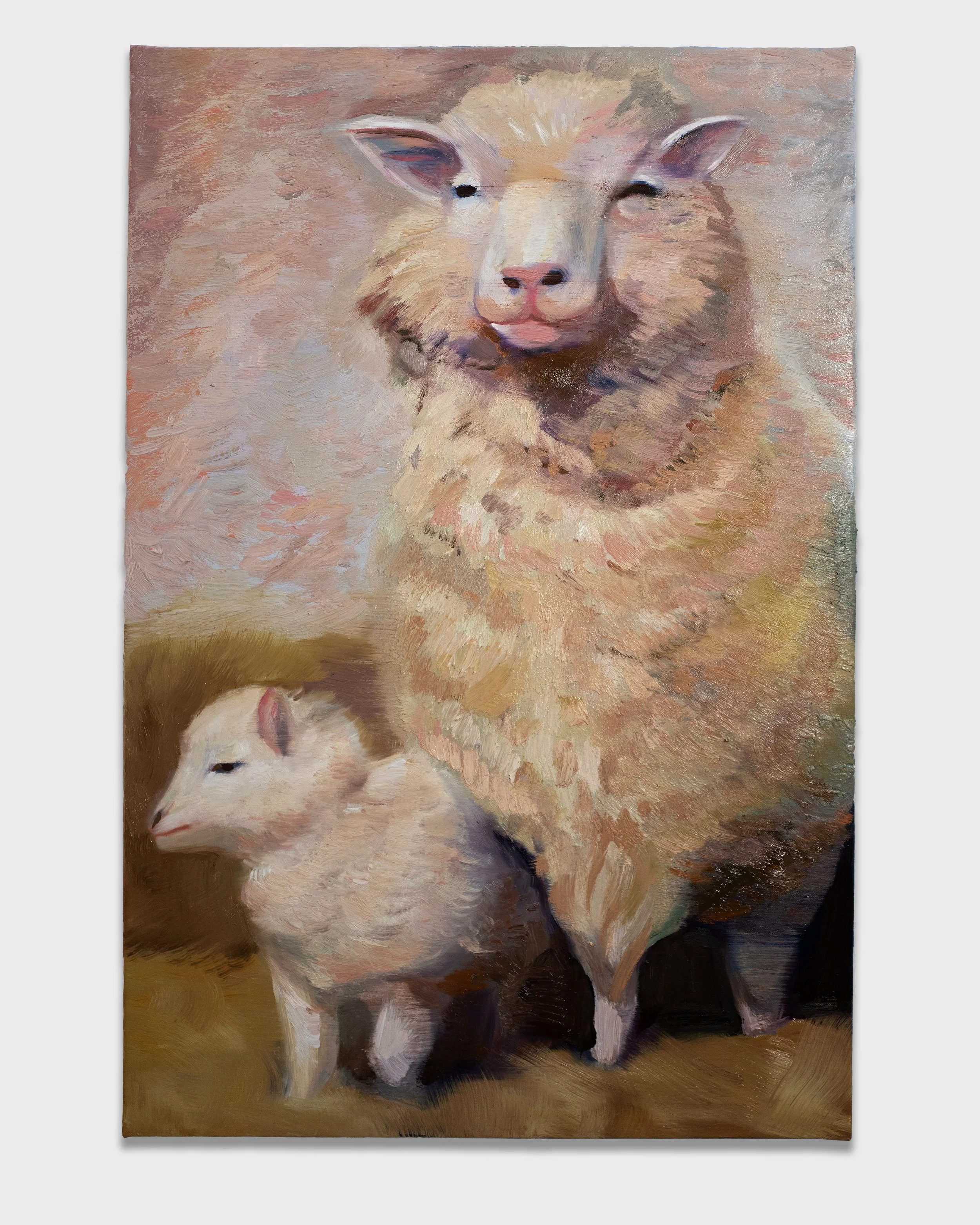
Dolly and Bonnie, 2026
Oil on linen
81 x 54 cm (32 x 22 in)
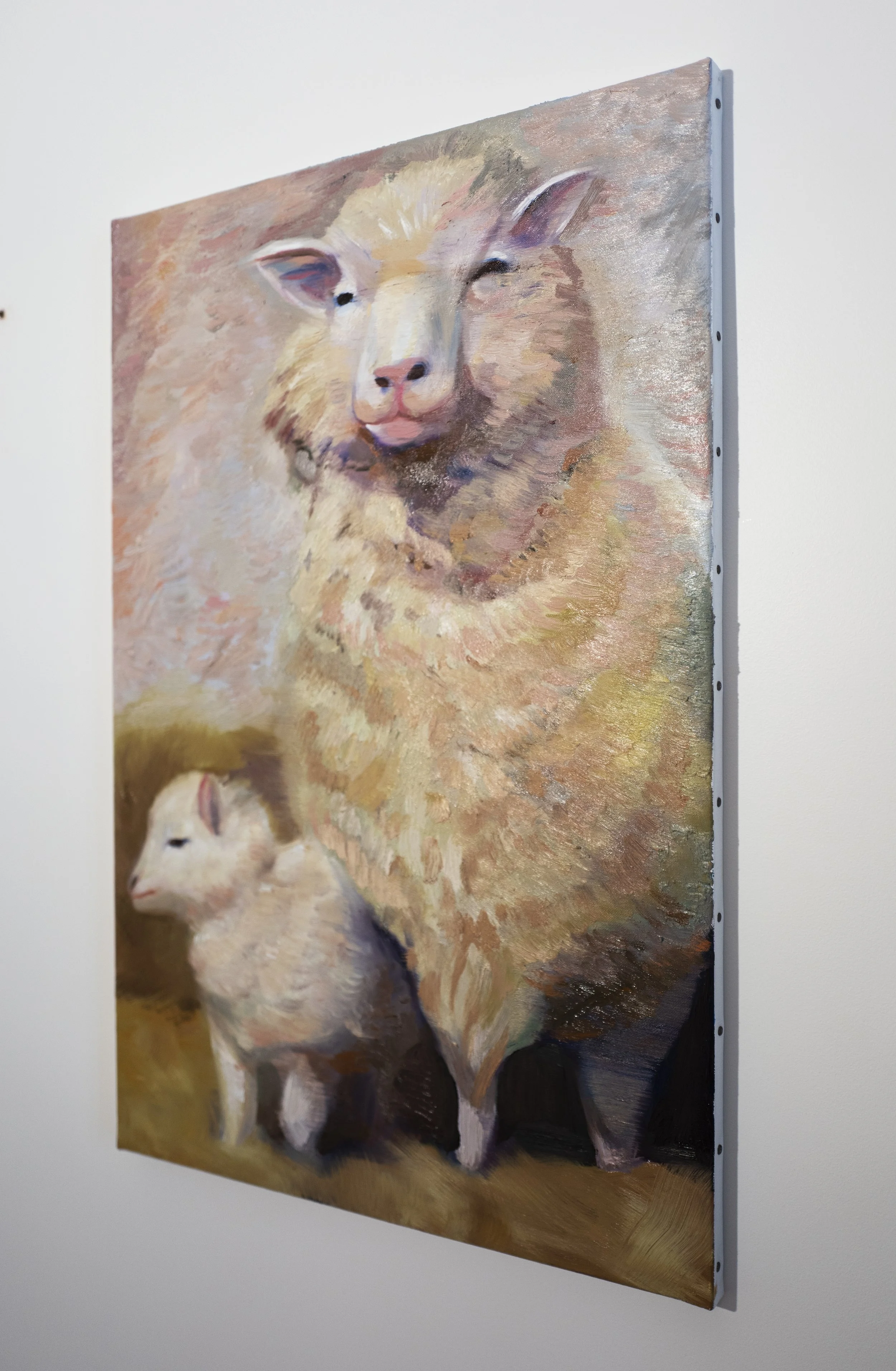
Dolly and Bonnie (2026) extend Tan Mu's sustained engagement with the legacy of cloning technology, returning to the figure of Dolly the sheep five years after her earlier painting Dolly (2021). Where the first work contemplated the cloned animal in isolation, a singular figure suspended between scientific fact and childhood memory, this companion piece introduces Bonnie, the first lamb born naturally to Dolly in April 1998. The painting depicts the two animals together: the larger ewe standing upright and frontal, gazing outward with an almost totemic stillness, while the smaller lamb turns away, poised at the threshold of departure. Their relationship within the composition is less a sentimental portrait than a philosophical proposition: the clone who produced life through natural means, and the offspring who, in her very ordinariness, became proof that a body assembled from replicated code could still participate in the unpredictable processes of biological continuity.
The birth of Bonnie in 1998 was widely understood as a confirmation that Dolly was, despite her origins, a functionally complete organism, capable of fertility and reproduction without further technological intervention. Tan Mu seizes on this moment not as scientific vindication but as a conceptual rupture. If Dolly's existence questioned the boundary between original and copy, Bonnie's arrival complicated the question further: she was not a clone, yet she descended from one. She was natural, yet her lineage began in a laboratory. In painting the two together, Tan Mu stages an encounter between engineered origin and organic continuation, between the constructed and the inherited, between the body that was made and the body that was born.
Rendered in the same intimate scale as its predecessor, Dolly and Bonnie retains the painterly blur that characterizes Tan Mu's treatment of memory-laden subjects. The thick, visible brushwork dissolves the specificity of photographic reference into something closer to recollection, as though the image has been filtered through time and subjectivity. The warm palette of ochres, pinks, and muted golds lends the scene a quality of tenderness without sentimentality, while the compositional asymmetry, the lamb positioned lower and turning leftward, introduces a quiet tension between proximity and separation, belonging and autonomy. Together with Dolly and the earlier IVF (2020), the work forms part of an expanding body of paintings that examine the entanglement of technology, reproduction, and identity at the cellular and symbolic levels of life.
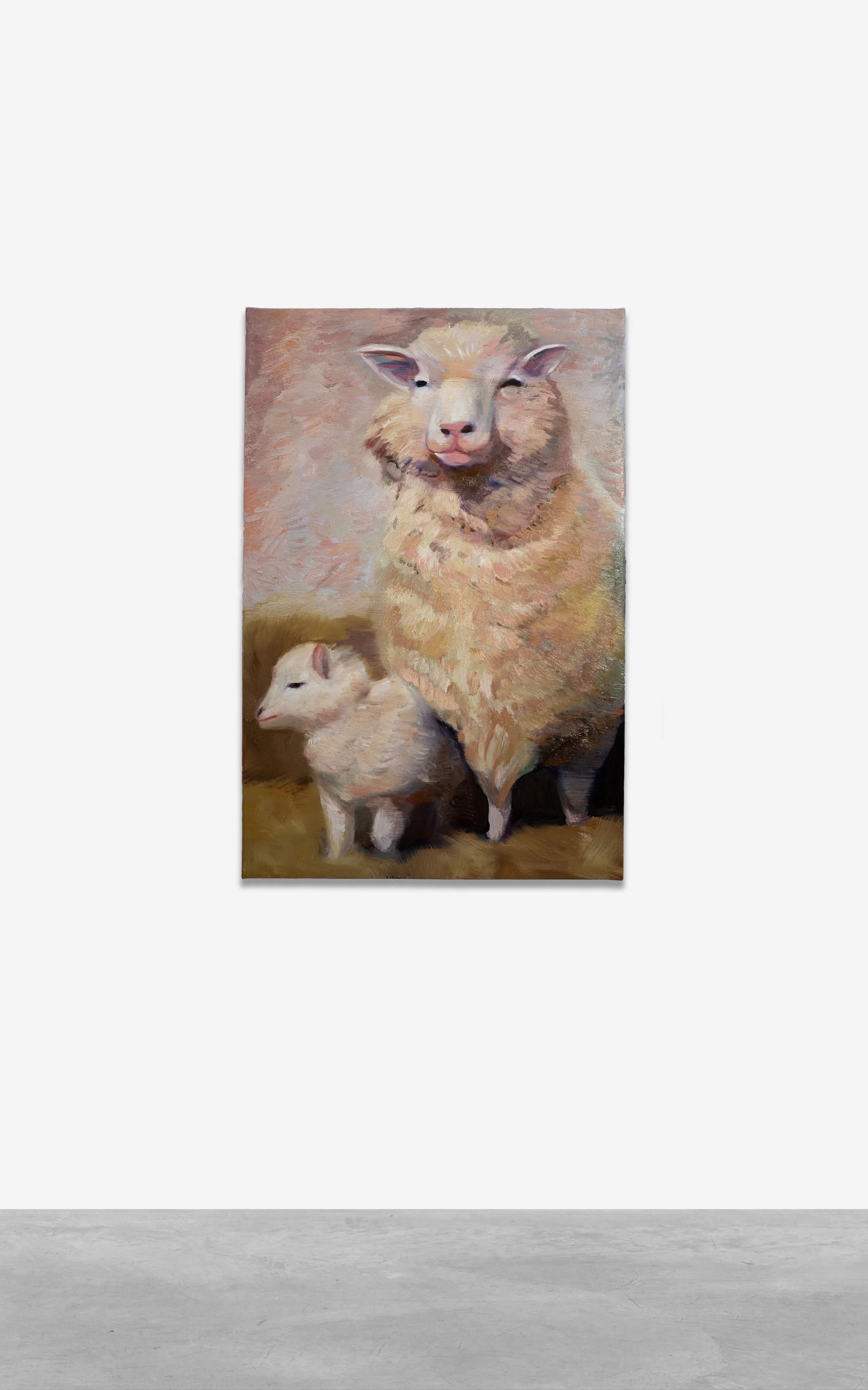
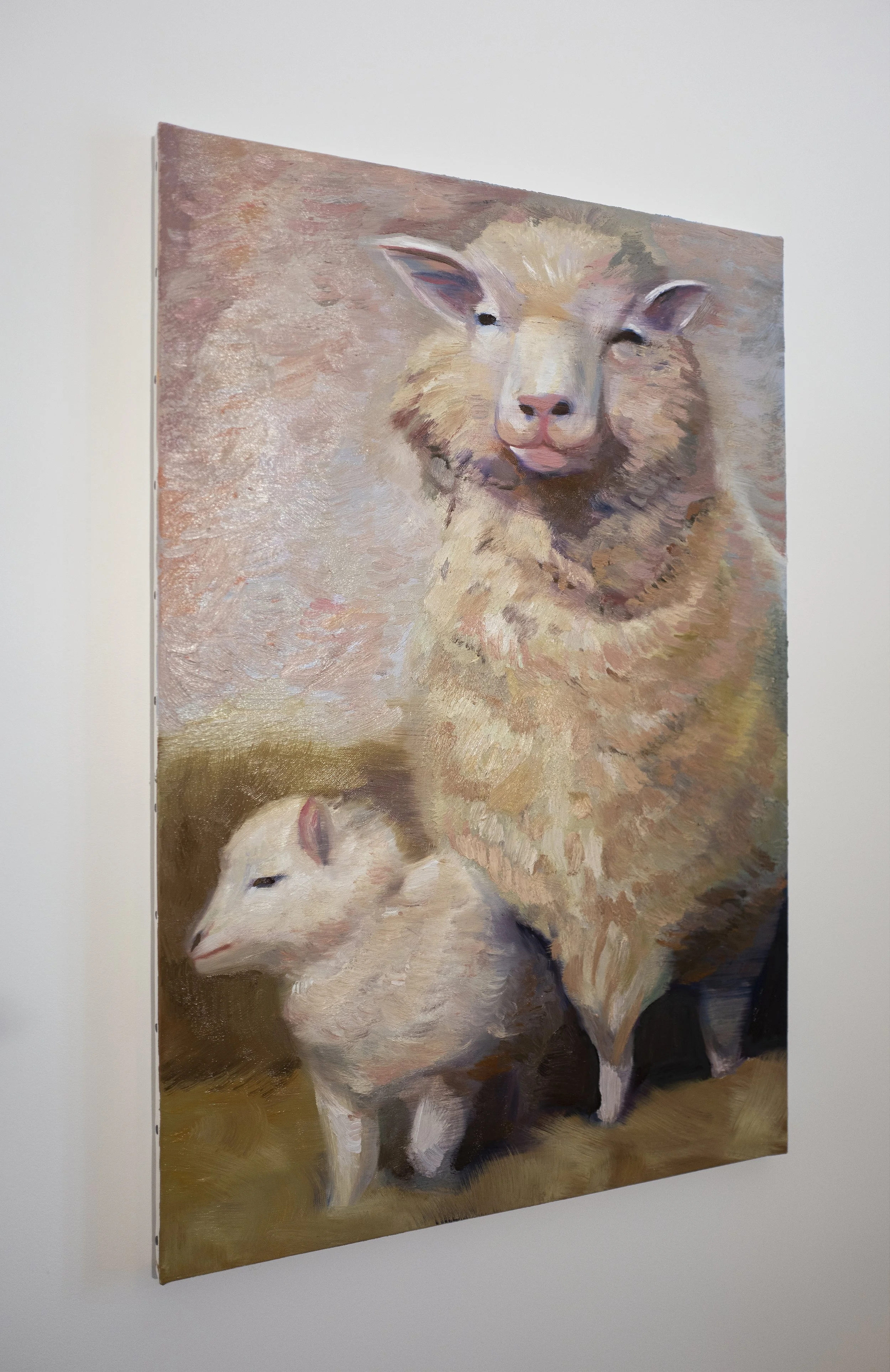
Q: Dolly and Bonnie returns to the subject of your earlier painting Dolly (2021). What led you to revisit this subject five years later?
Tan Mu: When I painted Dolly in 2021, my focus was on the cloned animal herself and the questions she raised about identity, memory, and replication. But over the following years, as I continued working on pieces that dealt with the relationship between technology and life, I kept thinking about what happened after the cloning. Dolly was not an endpoint. She lived, she was bred naturally with a Welsh Mountain ram, and she gave birth to Bonnie in 1998. That fact stayed with me. Here was an animal whose very existence was the result of radical technological intervention, and yet she went on to reproduce through the most ancient and ordinary biological process. That transition from the engineered to the natural felt like it deserved its own painting. I wanted to sit with the relationship between those two bodies, the one that was made and the one that was born, and to think about what passes between them.
Q: The composition places the two figures in an unusual spatial relationship. Could you speak to the choices you made in arranging them?
Tan Mu: I spent a long time considering how to position Dolly and Bonnie relative to each other. In the end, I painted Dolly standing frontally, almost looking directly at the viewer, while Bonnie is lower and turned slightly away, as though she is about to move out of the frame. This was deliberate. Dolly occupies the center of the composition with a kind of monumental stillness. She has always been a figure that the world looked at, studied, photographed, and debated. Her posture in the painting reflects that history of observation. Bonnie, by contrast, is not burdened by that same attention. She is simply a lamb. Her body language suggests motion, independence, a life that will unfold outside the frame of this particular story. I was interested in the tension between these two modes of presence: one defined by its origin, the other free to move beyond it.
Q: Your earlier Dolly painting used a blurred visual treatment to evoke memory. How does the painterly approach in this new work relate to that earlier strategy?
Tan Mu: The approach is related but not identical. In Dolly (2021), the blur was very much about the instability of my own childhood memory of learning about cloning. The image was deliberately uncertain, as though seen through the fog of recollection. In Dolly and Bonnie, the brushwork is still thick and visible, the forms still resist photographic precision, but the treatment is warmer and slightly more resolved. This shift reflects the nature of the subject. Dolly was about looking backward, trying to recover an image from the past. Dolly and Bonnie is about something different: the act of continuation, of life persisting beyond its point of origin. I wanted the paint surface to feel more grounded, more present, even while maintaining the sense that what we are looking at is filtered through time and interpretation. The warmth of the palette, the ochres and pinks, came intuitively. There is something tender about this subject that I did not want to suppress.
Q: How does this work connect to the broader themes in your practice, particularly the relationship between technology and the body?
Tan Mu: Throughout my work, I have been drawn to moments where technology and the body become entangled in ways that are difficult to separate. IVF (2020) examined the technological origin of life at the cellular level. Dolly (2021) addressed the replication of an entire organism. Dolly and Bonnie takes the next step by asking what happens when a technologically produced body enters into natural processes of reproduction. Bonnie was not engineered. She was conceived and born through biological means. And yet her existence is inseparable from the technological history that produced her mother. This is not unique to sheep. We live in a world where the boundaries between the natural and the technological are increasingly blurred, where bodies shaped by medical intervention go on to live, reproduce, and generate new life. I think of Dolly and Bonnie as a painting about inheritance in the broadest sense: not just genetic inheritance, but the inheritance of a condition, a history, a way of being in the world that was initiated by technology but continued through nature.
Q: You have spoken before about cloning in relation to questions of identity and originality. Does Bonnie change how you think about those questions?
Tan Mu: Very much so. Dolly challenged the idea of originality because she was a genetic copy. She was identical to another sheep, and that fact troubled our assumptions about uniqueness and individuality. But Bonnie introduces a different kind of complexity. She is not a copy of anything. She carries genetic material from Dolly and from her father, a Welsh Mountain ram, combined through natural reproduction. She is, in every conventional sense, an original. And yet she could not exist without the act of cloning that preceded her. So the question shifts from whether a copy can be considered an individual to whether an original can ever be fully separated from the technological conditions that made it possible. This is a question that extends far beyond biology. It touches on how we think about authorship, inheritance, and the origins of anything we call new. In painting Dolly and Bonnie together, I wanted to hold both of these questions in the same frame without resolving them.