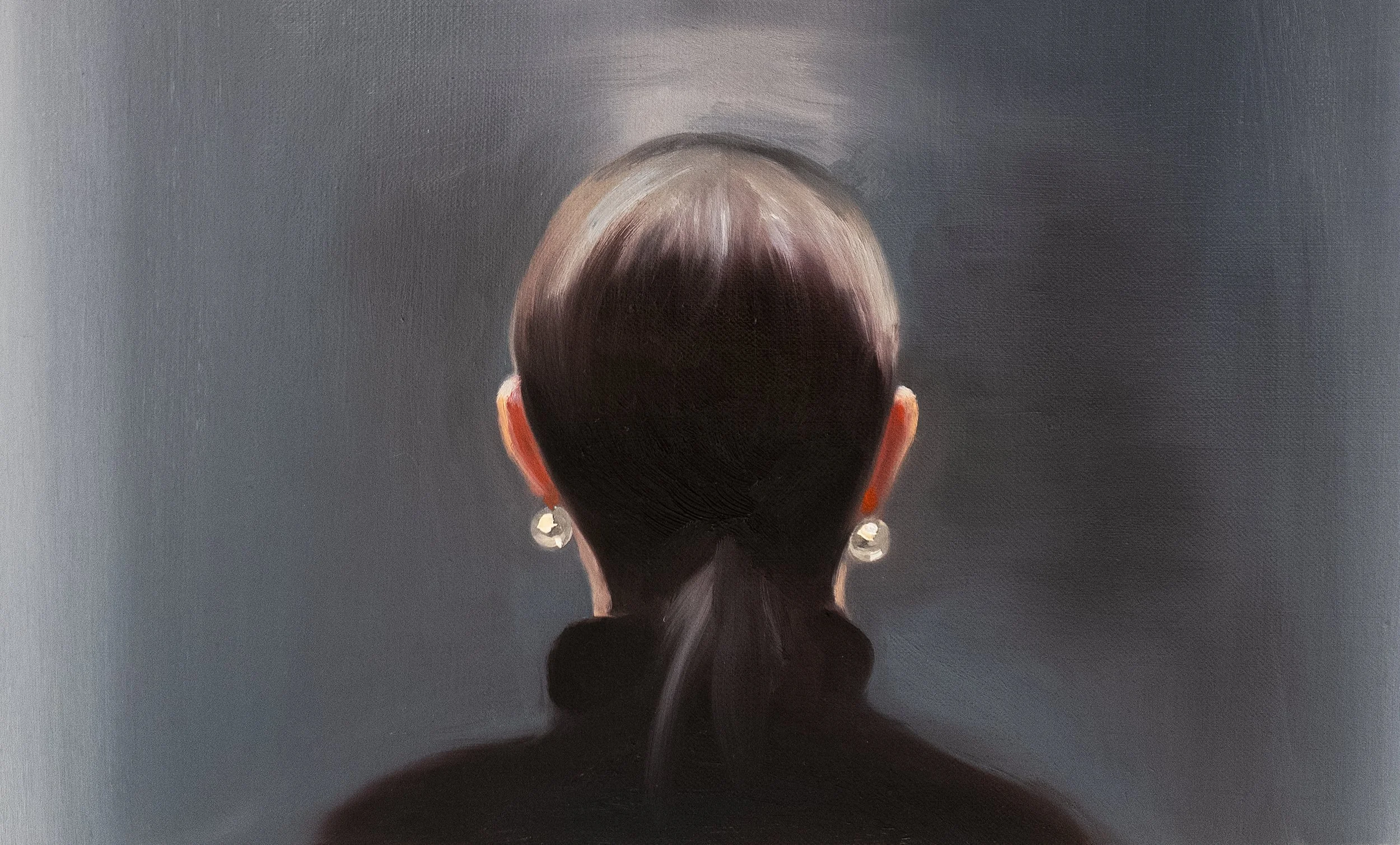
Quantum Gaze 02, 2026
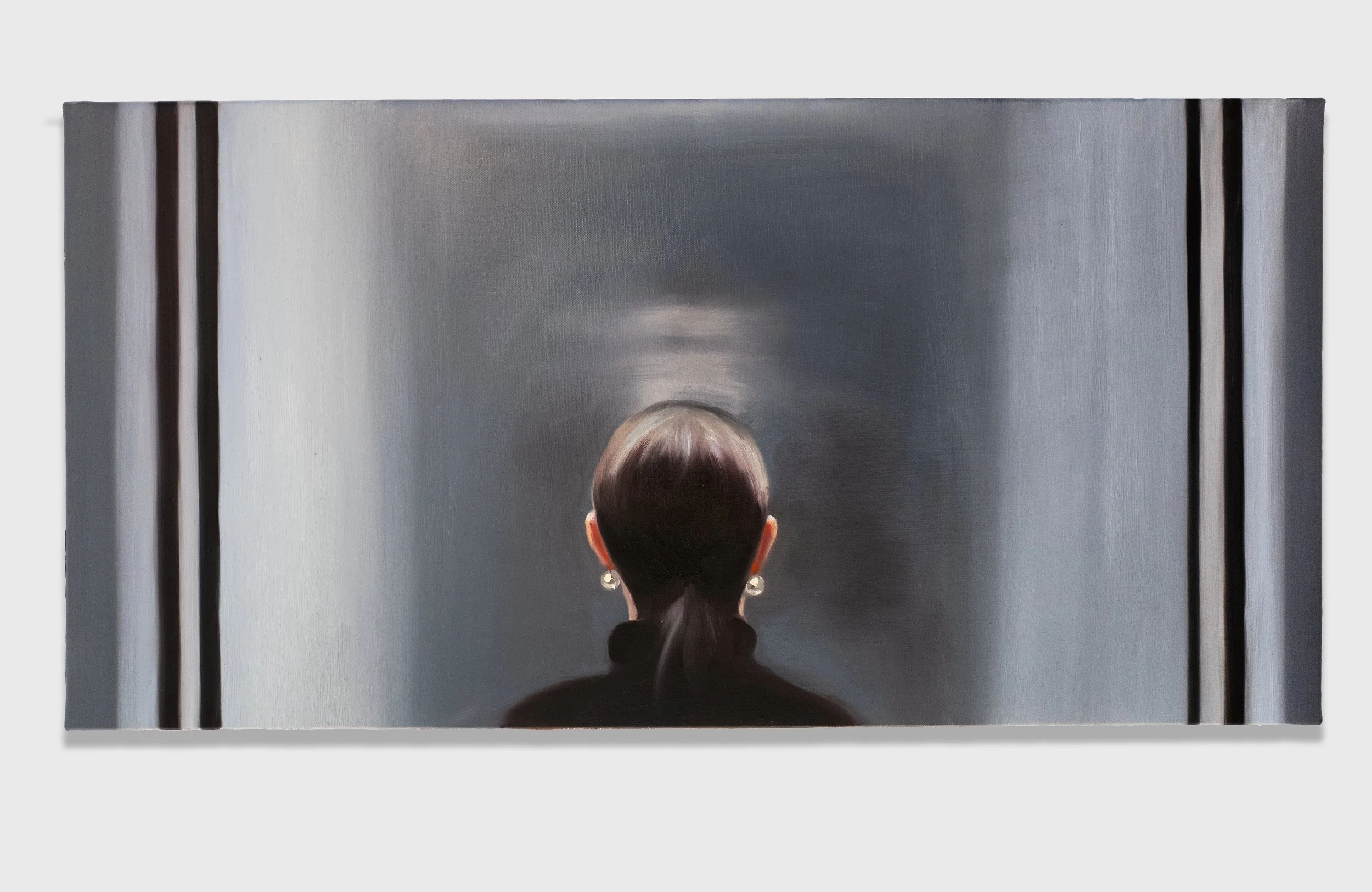
Quantum Gaze 02, 2026
Oil on linen
40 x 80 cm (16 x 31 1/2 in)
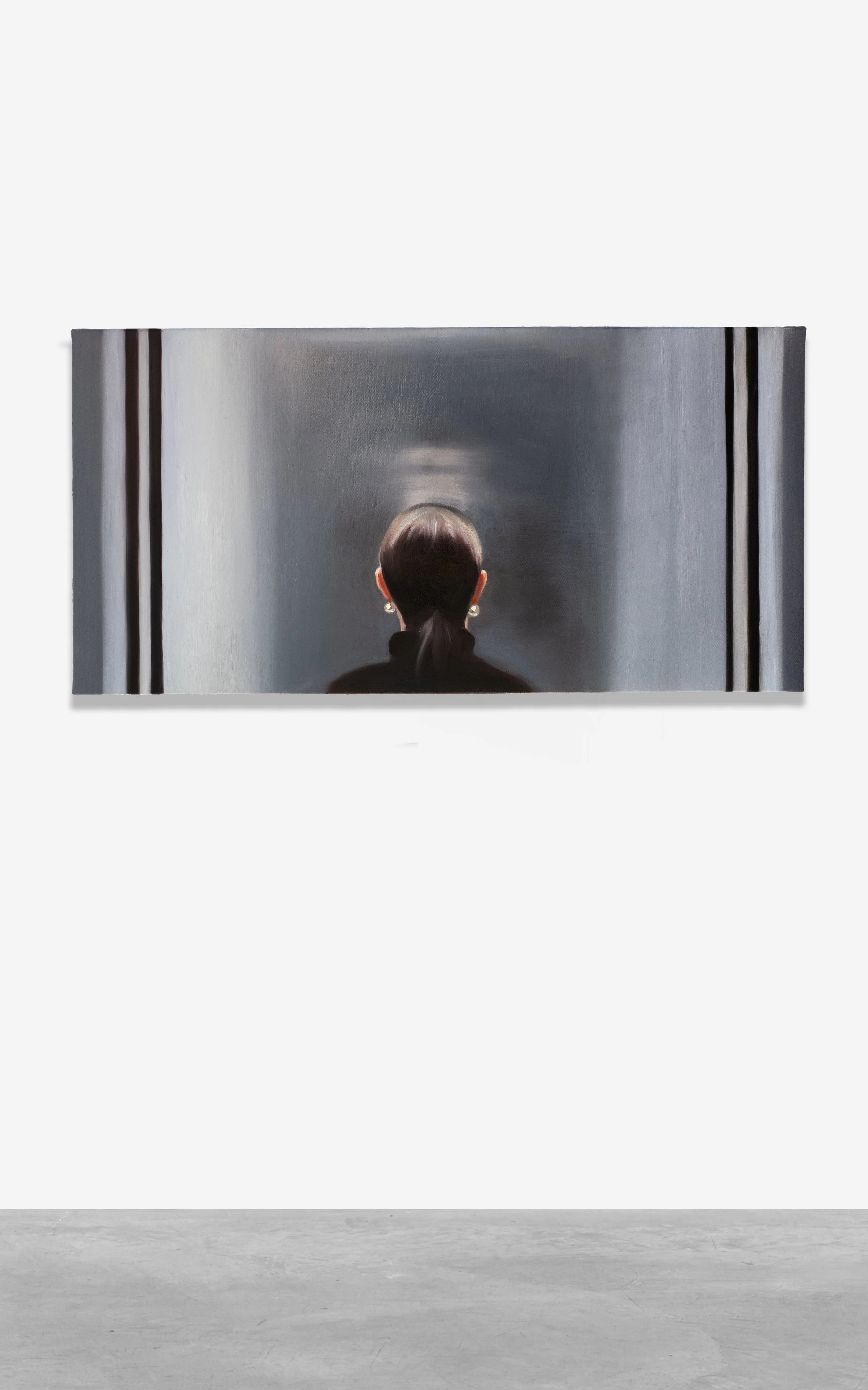
In Quantum Computer (2020), Tan Mu painted IBM's quantum system as an external object and realized, upon completion, that she had made a portrait. In the monumental Quantum Gaze (2023), she moved inside the machine, rendering its cooling systems and superconducting circuits as a form of interior architecture suspended between material reality and imagination. Quantum Gaze II (2026) completes the sequence by introducing what the earlier works always implied but never depicted: the human body. A figure seen from behind, her dark hair drawn back, pearl earrings catching the ambient light, stands before the polished casing of a quantum computing system. She does not operate the machine or study a readout. She looks. The painting shifts its subject from the technology itself to the act of perception, staging an encounter between embodied human cognition and a form of intelligence that operates beyond the reach of the senses.
The reflective steel-blue surface of the quantum computer returns light and image while revealing nothing of the processes it contains. Behind this exterior, qubits exist in superposition, cryogenic systems operate near absolute zero, and computations unfold in a domain that no human sensory apparatus can directly access. What the figure encounters is a threshold: a surface that offers the appearance of accessibility while concealing an interior logic fundamentally unlike her own. Tan Mu transposes into painting a principle from quantum mechanics known as the observer effect, in which the act of measurement collapses superposition into a definite state. The painting holds this collapse in suspension. It does not resolve whether the figure perceives the machine or the machine, in its reflective silence, perceives her. The boundary between observer and observed remains genuinely unstable, and the work draws its power from refusing to settle on either side.
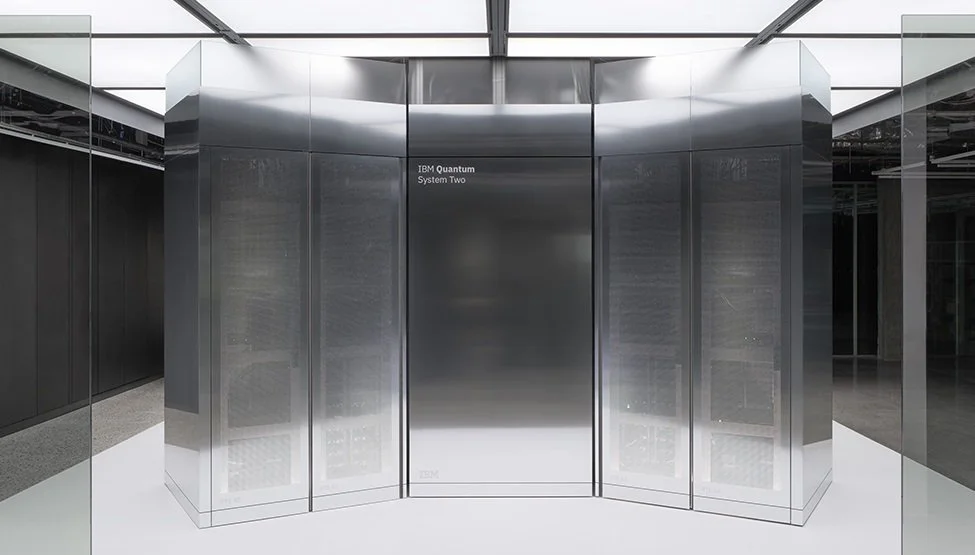
IBM Quantum System Two is the first modular utility-scaled quantum computer system, unveiled by IBM on December 4, 2023.
The palette is restrained: steel blues, silvers, and grays, punctuated only by the warmth of skin and the small white points of the pearl earrings, details that anchor the figure as a particular person within an otherwise anonymous encounter. Tan Mu returns here to the intimate scale of Quantum Computer (2020) after the nearly two-and-a-half-meter height of Quantum Gaze (2023). The shift is deliberate. This is a painting about proximity, not spectacle. Where the earlier work presented the machine as a portrait of human intelligence externalized, this work reintroduces the body itself, not as creator or operator but as witness. Read alongside works such as MRI (2021), Synapse (2023), and the Signal series, Quantum Gaze II extends Tan Mu's ongoing investigation into what she calls the fabric of memory: the territory where internal biological processes and external technological systems converge, overlap, and fail to fully translate into one another.
Q: Quantum Gaze II is the third work in your series engaging with quantum computing. What led you to return to this subject?
Tan Mu: Each of the three paintings represents a fundamentally different relationship to the same technology. In Quantum Computer (2020), I was observing the machine from the outside, treating it as an object that could be recorded. When I finished, I realized the painting functioned as a portrait. That realization changed how I understood the work. It was not a still life. It was a reflection of how we externalize intelligence, memory, and cognition. In Quantum Gaze (2023), I moved inside the machine, painting its internal structure as a way to understand its logic from within. That process took nearly three years of planning before I touched the canvas. With Quantum Gaze II, I pulled back to include the human figure for the first time. In the earlier works, the viewer occupied the position of the observer, standing outside the frame. Now the observer is inside the painting, and the viewer is watching someone else look. The question shifts from what does this technology look like to what happens to the person who stands before something that exceeds her capacity to perceive it.
Q: The figure is shown from behind. Why withhold her face?
Tan Mu: If I had painted the figure facing the viewer, the painting would have become a conventional portrait and the relationship between person and machine would have been secondary. Turning her away places the viewer in the position of watching someone else's act of looking. You see what she sees, but you also see her seeing it. This creates a layered structure of observation that connects to the observer effect in quantum physics, where the act of measurement changes the system being measured. Here, looking itself becomes the subject. The pearl earrings were important to me. They are the only identifying detail, small points of warmth and light against the cool surface of the machine. They prevent the figure from becoming an abstraction. She is a specific person in a specific encounter, even though her identity remains withheld. I think of them the way a single remembered detail can hold an entire experience in place.
Q: The reflective surface of the quantum computer dominates the composition. How did you approach painting it?
Tan Mu: The casing of IBM's quantum systems has fascinated me since I first began researching them around 2019, when the IBM Q System One was unveiled. The surface is beautiful and opaque at the same time. It returns light and image while concealing everything that makes the machine extraordinary. The qubits operate at temperatures near absolute zero, in conditions of extreme isolation from the external environment. None of that is visible. I wanted the painted surface to function the same way, to offer the viewer something that appears accessible but resists penetration. The steel blues and silvers are smooth and controlled, more precise than my handling of, say, the textured brushwork in Dolly and Bonnie. The machine demanded that restraint. But there is also a subtle instability in the reflections, a slight ambiguity about where the surface ends and the surrounding space begins. That instability is central. It mirrors the condition of superposition itself, where a system exists in multiple states until observation forces it into one. I wanted the boundary between observer and observed to remain genuinely unresolved in the painting, just as it remains unresolved in physics.
Q: In earlier works, you described the quantum computer as a portrait of humanity. How does the presence of the human figure in this painting change that idea?
Tan Mu: In Quantum Computer (2020), I saw the machine's complex structure as mirroring the human body, its processing logic as paralleling cognition and memory. The machine was a portrait because it reflected human intelligence back at us in externalized form. Those analogies still hold. But Quantum Gaze II adds something new. By placing the figure in front of the machine, I am staging a confrontation between two forms of intelligence: the embodied, perceptual intelligence of the human body and the computational, probabilistic intelligence of the quantum system. The figure carries her own memory, her own perceptual history. The machine carries a form of possibility that exists in superposition. They face each other, and neither can fully access the other. The person cannot perceive qubits in superposition. The machine cannot experience the sensation of standing before something vast and unknowable. That gap is not merely technical. It is existential. The painting is not a celebration of technology or a critique of it. It is an image of two systems of knowing, face to face, separated by a distance that no amount of looking can close.
Q: Your work spans subjects from submarine cables and data infrastructure to cells, synapses, and cloning. How does this painting connect to that broader investigation?
Tan Mu: My work has always been concerned with the structures that shape contemporary existence but remain largely invisible. The Signal series examines the physical infrastructure of global communication, the submarine cables that carry data and, in a sense, collective memory across oceans. Works like MRI (2021) and Synapse (2023) examine the biological infrastructure of cognition and consciousness. Earlier paintings on IVF, chromosomes, and embryonic development explore the biological infrastructure of life itself. The quantum paintings examine the computational infrastructure of intelligence. What connects all of these is that they operate beneath or beyond ordinary perception. They shape the world without being seen. I think this condition defines our moment. We are surrounded by systems we have built but cannot fully perceive, systems that increasingly determine how we live, think, and relate to one another. A quantum computer is perhaps the most extreme example: a machine whose entire operational logic is inaccessible to direct human observation. Quantum Gaze II stages that condition as an encounter between a single body and a single machine, compressed into a painting small enough to stand close to. Painting, for me, is a way of making visible what otherwise remains hidden. Not to explain it, but to hold it still long enough that the viewer can feel its weight.